
Yes, Google reviews help SEO. But there is a specific way they work, and most businesses get this wrong.
Google reviews directly impact your local SEO, meaning how your business appears in Google Maps and the local 3-pack results. They are one of the confirmed signals Google uses to decide which businesses to show when someone searches for a service near them. According to Whitespark’s 2026 Local Search Ranking Factors report, review signals rank among the top 10 factors for local pack visibility.
This is not speculation. Google has documented it. The question is not whether reviews matter. The question is how they work and what you actually need to do about it.
What Google Actually Says About Reviews and Rankings
Google uses three main factors to rank local businesses: Relevance, Distance, and Prominence.
You cannot control the distance for every searcher. Relevance is mostly handled through your Google Business Profile categories and description. But Prominence? That is where reviews come in.
Prominence refers to how well-known and trusted your business appears online. Google looks at your review count, your average rating, and how consistently you are receiving new feedback. A business with strong review signals appears more established to Google, and that directly influences where you show up.
Google’s own documentation states that positive reviews can improve your business’s visibility in local search results. That is as close to an official confirmation as you will get.
One thing to be clear about: reviews affect your local search ranking, not your standard organic page ranking. If someone searches “how to fix a leaky faucet,” reviews will not push your blog post higher. But if someone searches “plumber near me,” reviews become one of the most important signals Google looks at.
Local SEO vs Organic SEO: Reviews Work Differently in Both
For the Google Map Pack, reviews are a direct ranking factor. Full stop.
For organic search results, the effect is indirect. Reviews improve your click-through rate, build trust, and bring in more engaged visitors. Those user behavior signals feed back into Google’s algorithm over time.
Think about it practically. If your business shows up on page one of Google with a 4.8-star rating and 200 reviews next to it, more people click. More clicks send a positive engagement signal to Google. That can gradually lift your organic visibility too, but it is a slower and less direct path.
For local search, the impact is immediate and measurable. Appearing in the local 3-pack drives approximately 126% more traffic and 93% more customer actions than appearing in positions 4 through 10, according to SocialPilot.
A SEMRush study found that businesses ranking in the number one spot on Google Maps had roughly 100 more reviews than the business in position two. The average star rating between the two was similar. What separated them was volume.
The Three Review Signals That Actually Affect Your Ranking
Not all review activity carries the same weight. Google pays attention to three specific signals.
1. Review Volume
More reviews tell Google your business is active and trusted by real customers.
Sterling Sky, a well-respected local SEO agency, published a 2025 case study showing that businesses saw clear ranking improvements once they crossed 10 reviews. Beyond that point, gains were more gradual. But the message is clear: a handful of reviews is not enough if your competitors have dozens.
Volume matters. It just does not work in isolation.
2. Review Recency
This is where many businesses fall behind without realizing it.
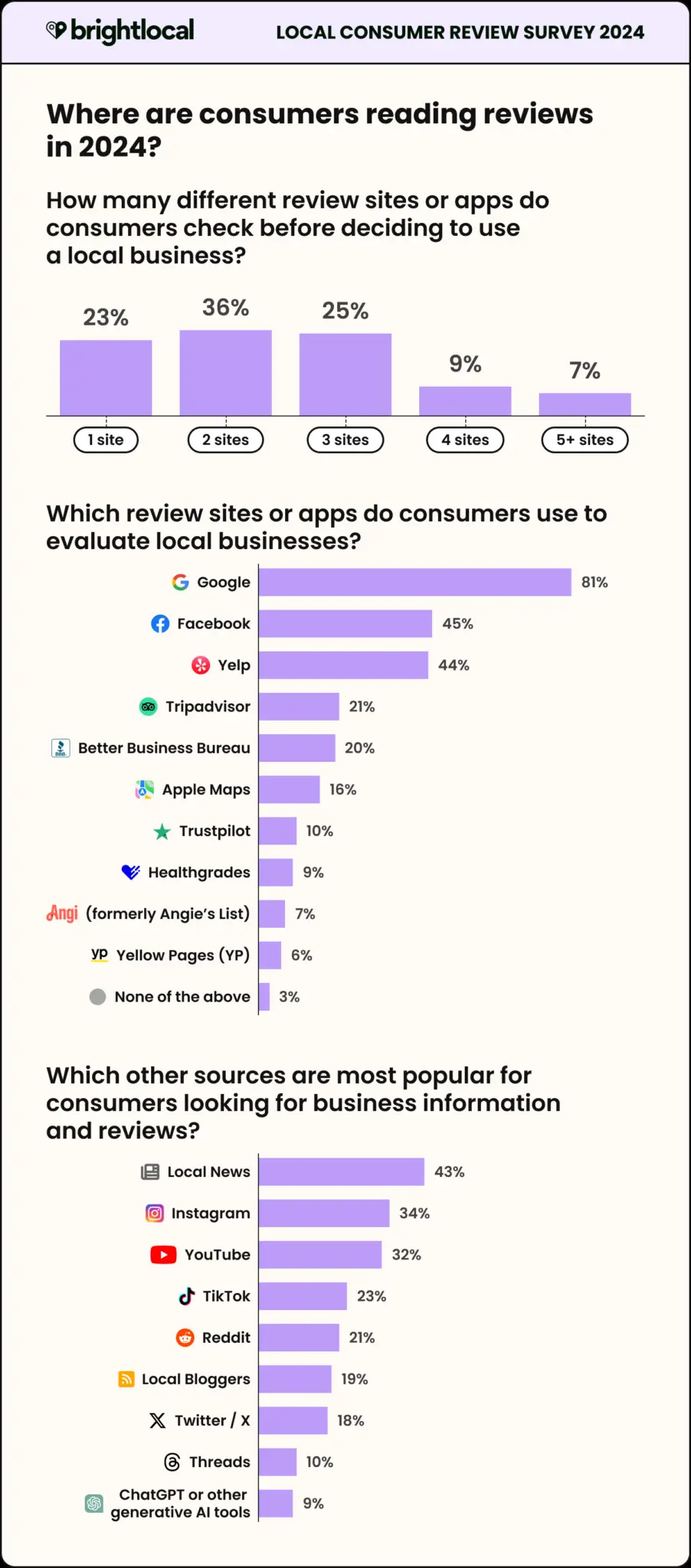
BrightLocal’s 2024 Local Consumer Review Survey found that 73% of customers only trust reviews written in the past month. Google’s algorithm reflects this behavior. A business with 500 reviews but no new ones in three months looks stagnant.
Local SEO practitioners have documented what some call the “18-day rule”: rankings can visibly drop when a business stops receiving reviews for even three weeks. A consistent flow of new reviews signals ongoing customer engagement, which is exactly what Google wants to see.
3. Review Quality and Star Rating
Your star rating shapes how many people click on your listing, even before they visit your website.
Data from Moz shows that businesses with a 4.5-star average earn up to 25% more clicks than a competitor rated 3.5 stars, even if the lower-rated business ranks higher. Higher click-through rates send positive signals back to Google, which can further support your local ranking over time.
Reviews account for approximately 10% of local SEO ranking factors according to LocaliQ. That might sound like a small number, but in competitive local markets, 10% is often the gap between page one and page two.
Read Also: Is Hiring an SEO Company Worth It?
Keywords Inside Reviews: The SEO Signal Most Businesses Ignore
When a customer writes a detailed review mentioning your specific services, Google reads that content.
If multiple reviews mention “emergency roof repair in Ahmedabad” or “same-day AC service,” Google starts associating your business more strongly with those search terms. It is user-generated content working as a relevance signal, and you did not write a single word of it.
Reviews with 50 or more words give Google significantly more context to work with than a star-only rating. A review that says “5 stars” tells Google almost nothing. A review that describes the service, the problem it solved, the team involved, and the location tells Google quite a lot.
According to Wiser Notify’s 2025 data, 88% of customers read Google reviews before engaging with a local business. The reviews your customers write are being read by both Google and future customers at the same time.
You cannot tell customers what to write. But you can make the process easy enough that they write more naturally detailed reviews when prompted at the right moment.
Does Responding to Google Reviews Help SEO?
Responding to reviews is not a confirmed direct ranking factor. But that does not mean it is optional.
Google publicly recommends that business owners respond to reviews. They describe it as a way to engage customers and stand out in Search and Maps. An active, responsive business looks different from a business that ignores its customers publicly.
Here is the data that should make this a non-negotiable part of your process:
- 97% of review readers also read the business’s response (LocaliQ)
- 53% of customers expect a reply to a negative review within one week (ReviewTrackers)
- 63% of customers say the business never responded to their review (ReviewTrackers)
That last number is a real opportunity. Most businesses are not responding. If you do, you immediately stand out.
When you respond, you can naturally include your service type or location in the reply. For example: “Thank you for trusting us with your home renovation project in [City]. We are glad the team delivered on time.” That is natural. It adds a small relevance signal without being forced or spammy.
What Does Not Help, and What Can Actually Hurt
A few common shortcuts are worth avoiding.
Fake reviews. Google announced that it used Gemini AI to better detect review spam in 2024, reporting a 40% increase in review removal compared to the previous year (Search Engine Land, 2025). Getting caught with fake reviews can lead to your profile being penalized or your reviews wiped out entirely.
Incentivized reviews. Offering discounts or gifts in exchange for a positive review violates Google’s policies. It also tends to produce generic, low-quality reviews that do not help your relevance signals anyway.
Review spikes. Getting 50 reviews in one week after months of silence looks unnatural. Google’s algorithm is built to spot this. Ten genuine reviews collected over two months are far more valuable than 50 collected in a burst.
Star-only ratings with no text. These carry minimal SEO value. They count toward your volume, but they give Google nothing to work with in terms of relevance. Encourage customers to share a few sentences about their experience.
How to Know If a Review Gap Is Hurting Your Rankings
Open a new browser window and search for your main service plus your city. Look at the top three businesses in the Map Pack.
Compare them to your profile across three areas:
Rating gap: Are you 0.3 to 0.5 stars behind the top results? That is a visible disadvantage when customers are scanning options.
Volume gap: Do the top businesses have five to ten times more reviews than you? Google sees that as a trust and activity gap.
Momentum gap: Are your competitors consistently getting new reviews every week while yours have been quiet for a month? That recency gap compounds over time.
If you are behind on two of these three, reviews are one of the fastest gaps you can realistically close. Unlike technical SEO or link building, review generation is something you can start today with tools and processes already available to you.
A Simple Process to Get More Google Reviews the Right Way
The timing of your ask matters more than almost anything else.
Request a review within 24 to 48 hours of completing a service or delivering a positive experience. That is when the customer’s satisfaction is highest and the memory is fresh.
Make the process as easy as possible. A direct Google review link or a QR code at checkout removes every barrier between the intention and the action. Most reviews are written on mobile phones, so the path needs to be frictionless.
Train your team to ask naturally. A simple, personal ask like “Your feedback genuinely helps us grow. Would you mind sharing your experience on Google?” is far more effective than a generic automated message.
Do not script your customers. Do not offer incentives. Just ask, make it easy, and ask consistently. A steady flow of honest reviews beats an occasional burst every time.
Start Ranking Higher in Local Search Results
If your competitors are outranking you, chances are they have a stronger review profile. We help you close that gap with a proven approach focused on review volume, recency, and trust signals. We build a system that consistently brings in new reviews and improves your local SEO and customer engagement.
FAQs
Google reviews directly affect your local search rankings, specifically in the Google Map Pack and Google Maps results. They are part of Google’s “Prominence” signal, which measures how well-known and trusted your business appears online. They do not directly move standard organic page rankings, but they can improve click-through rates, which indirectly supports organic visibility over time.
There is no fixed number that guarantees a ranking improvement. Sterling Sky’s 2025 case study found that businesses saw a noticeable ranking lift after reaching 10 reviews. Beyond that, the gap between you and your competitors matters more than hitting a specific number. If the top-ranking business in your area has 200 reviews and you have 20, closing that gap will have a visible impact on your local rankings.
A higher star rating does not directly improve your ranking position, but it strongly influences how many people click on your listing. Businesses with a 4.5-star average earn up to 25% more clicks than a competitor rated 3.5 stars, even when ranked lower. More clicks send positive engagement signals back to Google, which can gradually support your local visibility over time.
Responding to reviews is not a confirmed direct ranking factor, but Google publicly recommends it as a best practice for local businesses. Responses improve customer trust, and 97% of review readers also read the business response. When you respond naturally using your service type or city name, you add a small relevance signal without over-optimizing. The bigger SEO benefit is indirect: active engagement signals to Google that your business is attentive and operating regularly.
Yes, significantly. Google used Gemini AI to detect review spam in 2024 and reported a 40% increase in review removal compared to the previous year. Fake reviews can lead to your entire review profile being wiped or your Google Business Profile being penalized. The short-term ranking gain is never worth the long-term damage to your profile and reputation.
Yes. When customers naturally mention your services, location, or specific offerings in their reviews, Google reads that content and uses it to better understand your business’s relevance for related search terms. A review mentioning “emergency plumbing in [city]” reinforces your relevance for that search query. You cannot tell customers what to write, but making the review process easy increases the likelihood of receiving naturally detailed, keyword-rich responses.
Consistency matters more than volume spikes. BrightLocal’s 2024 survey found that 73% of customers only trust reviews written in the past month. Local SEO research has shown that rankings can visibly drop when a business stops receiving reviews for even three weeks. Aim for a steady flow of new reviews rather than occasional bursts. Even two to four genuine reviews per month will outperform a one-time push of 50 reviews.
Yes. Service-area businesses (SABs) that hide their address on Google Business Profile still benefit from Google reviews as a local ranking signal. Reviews contribute to your Prominence score regardless of whether you display a physical location. For SABs, reviews are often even more important because potential customers cannot visit your storefront to form a judgment. The review profile becomes the primary trust signal.
Written reviews with 50 or more words carry the most value because they give Google more content to analyze for relevance signals. A detailed review mentioning the service provided, the outcome, and possibly the location gives Google significantly more context than a star-only rating. Reviews with thoughtful responses from the business owner add an additional layer of engagement that reinforces trust signals for both Google and future customers reading the listing.
There is no fixed timeline, but most local SEO practitioners report seeing movement within two to six weeks of a consistent review generation push, assuming other local SEO fundamentals are in place. Reviews are not an overnight ranking switch. They build over time alongside your overall local SEO profile. The businesses that maintain a steady stream of fresh, genuine reviews month after month tend to hold stronger and more stable rankings than those who rely on occasional spikes.
Conclusion
Google reviews are a confirmed local ranking signal. They feed into what Google calls Prominence, one of the three core factors used to rank local businesses in Search and Maps.
Volume, recency, and quality all matter together. A strategy built around only one of these three will underperform. A consistent approach that addresses all three builds ranking signals, improves your click-through rate, and earns trust from potential customers at the same time.
The businesses sitting at the top of local search results in your city are not there by accident. They have a review strategy, even if they have never called it that.
At VinzoTech, we help local businesses build a Google review strategy that is compliant, consistent, and built to grow local search visibility over time. If you want to close the review gap between you and your top competitors, we can help you do that with a process that works long-term.