
Every few years, people start saying that SEO is dead. We heard it after Google Panda, then again after Penguin, and later during the mobile-first indexing era. Now, after the rise of ChatGPT and Google AI Overviews, the same question is trending once again: “Is SEO finally dead in 2026?” After spending more than 10 years in the SEO industry, my answer is simple and clear: No, SEO is not dead. But it has changed dramatically.
SEO is not dead. But the version built on thin blog posts, keyword stuffing, and chasing position #1 for every informational query is gone. What works right now is different: it is about trust, authority, and being the source that both Google and AI tools choose to cite. If your strategy has not caught up to that reality, this article explains exactly what changed and what to do about it.
Why Everyone Keeps Saying “SEO is Dead”
The “SEO is dead” narrative is not new. It showed up after Google Panda in 2011, after Penguin in 2012, after mobile-first indexing, and after featured snippets. Practitioners adapted every single time.
This time, the panic is louder because some of the data actually support the concern.
HubSpot, a company with one of the most respected SEO teams in the world, saw its monthly organic visits drop from approximately 13.5 million in November 2024 to less than 7 million by December 2024, continuing to decline in the months that followed (The Digital Bloom, 2025). When that happened, an industry analyst on LinkedIn put it plainly: “If HubSpot, with one of the best SEO teams in the world, can experience this, none of us are safe.”
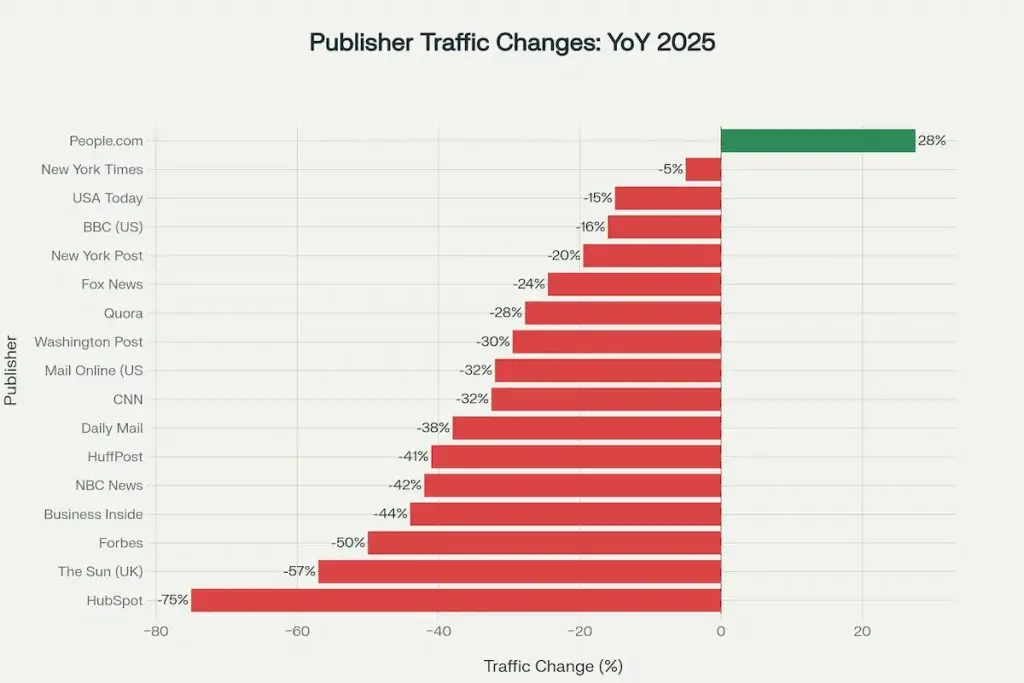
On Reddit’s r/SEO and r/marketing, threads asking whether organic traffic is dead regularly reach the front page. Real practitioners post traffic screenshots, some showing 30%, 40%, even 60% drops in six months. The concern is not manufactured. The pain is real.
Writer Tohbie Adelaja captured the sentiment circulating across LinkedIn discussions: “SEO in 2025 is no longer the main meal. It’s a garnish. You’re buried behind Reddit posts, YouTube links, and AI summaries anyway.”
That is the frustration. But frustration is not the full picture. The data tells a more complicated story.
What Google AI Overviews Actually Did to Organic Traffic
Google’s AI Overviews (AIOs) are the single biggest structural shift to search in over a decade. They appear at the top of the search results page and answer the user’s question directly before they see a single organic result.
The rollout has been fast.
According to Semrush’s AI Overviews Study (2025), AI Overviews appeared in 13.14% of Google searches in March 2025, up from 6.49% in January, nearly doubling in three months. By January 2026, that number had grown to 25.8% of all US searches, according to Stackmatix.
The click impact is measurable and significant.
Seer Interactive (September 2025) found that organic CTR dropped 61% for queries where AI Overviews appear from 1.76% down to 0.61% over 15 months. Pew Research Center (July 2025) found that when a Google AI summary is present, users click an external link only 8% of the time, compared to 15% when no summary is shown.
After Google’s December 2025 Core Update, AI Overviews expanded further now appearing for approximately 40% more queries than before the update (Kambrain, 2025).
Some industries were hit far harder than others. B2B technology saw AI Overview presence jump from 36% to 70% of SERPs. Health-related queries now face a 51.6% AI Overview rate. News publishers took compounding losses from both AIOs and the December 2025 core update (Stackmatix, 2026).
The Zero-Click Reality
In Google’s AI Mode, a newer search experience, Semrush data from September 2025 found that 93% of searches end without a single click to an external website. Pew Research confirmed that only 1% of users click a link inside an AI Overview.
For any business that built its traffic strategy on top-of-funnel informational content, this is a real and immediate problem.
But Total Traffic Did Not Collapse
Here is where the panic diverges from the full data set.
Google itself stated in August 2025 that total organic click volume from Google Search was “relatively stable year over year. “Search Engine Land’s coverage of Graphite data (January 2026) showed US organic search traffic down 2.5% year over year a real decline, but nothing close to the apocalypse version of the story. The largest sites actually grew organic traffic by about 1.6%.
The damage is concentrated. Mid-sized publishers relying on informational queries took the hardest hits. Commercial and transactional keywords, the ones that drive actual business revenue, are far less affected by AI Overviews.
ChatGPT and AI Search – Is Google Actually Losing?
A lot of the fear around SEO is tied to a broader question: Is ChatGPT replacing Google? Are people searching less?
The numbers give a clear answer.
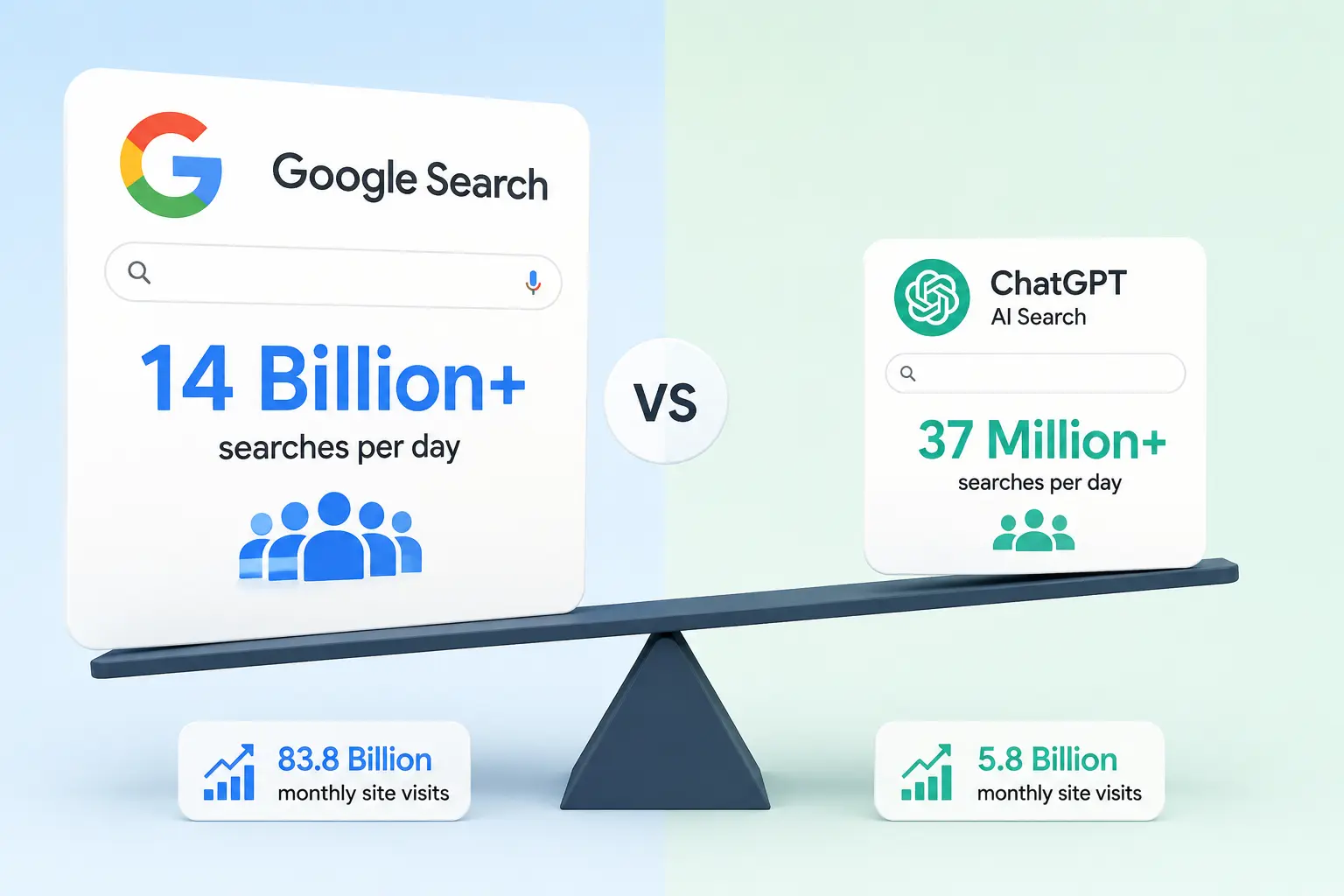
In early 2025, Google processed over 14 billion searches per day. ChatGPT handled around 37 million. That is 373 times fewer searches, according to analysis shared by Contentful. In August 2025, ChatGPT recorded 5.8 billion total site visits while Google saw 83.8 billion, according to Break The Web.
In client-level analytics data reviewed by Grow & Convert (2026), traffic from ChatGPT represented less than 5% of what those same sites received from Google organic. AI search is real and growing, but it has not come close to displacing Google.
There is another reason AI search has not overtaken traditional search: people do not fully trust it yet.
AI tools hallucinate. They make confident mistakes. They sometimes fabricate citations. So users double-check. They go to Reddit, TikTok, niche forums, and yes, back to Google to verify what an AI told them. As Break The Web noted, people want lived experience and real human judgment, not stitched-together summaries.
AI search is taking the quick informational queries that never had strong commercial intent anyway. Google retains the searches that actually drive business outcomes.
So What Actually Changed?
This is the honest breakdown, not panic, not dismissal.
What Is Genuinely Harder Now
Informational content, how-to guides, definitions, and question-answer posts are being displaced at the top of the SERP by AI Overviews. If your content strategy relied heavily on “what is X” and “how to Y” blog posts to drive traffic, that traffic is shrinking.
Thin content is finished. Templated articles built for volume rather than depth get no traction in the current environment. Google’s helpful content guidelines explicitly target this type of output, and the December 2025 core update accelerated the penalty.
Mid-sized publishers are squeezed between AI Overviews eating their informational traffic and larger brands dominating the commercial results they cannot compete for. It is a difficult position.
What Still Works – and What Works Better
Here is what the data actually shows for businesses with the right strategy in place.
Sites that earn citations inside AI Overviews see CTR increases of up to 35%, and brands mentioned in AI responses experience 91% higher paid CTR, a visibility halo effect that extends beyond organic rankings (Stackmatix, 2026).
Transactional and commercial-intent pages service pages, product pages, comparison pages, and local landing pages are not being replaced by AI Overviews to the same degree. These are the pages that drive actual revenue, and they still depend heavily on organic search.
Taylor Scher SEO’s analysis found that 54.5% of AI Overview citations now come from pages that rank organically, up from 32.3% sixteen months prior. Ranking well and being cited by AI are not separate goals. They feed each other.
Google’s December 2025 update specifically targeted low-quality AI-generated spam. Content built around genuine expertise, original research, and real author credentials is not being penalized; it is being rewarded (Kambrain, 2025).
E-E-A-T (Experience, Expertise, Authoritativeness, Trustworthiness) has never mattered more. Google is getting better at detecting whether the person behind the content actually knows what they are talking about.
Enter GEO – Generative Engine Optimization
While SEO focuses on ranking in traditional search results, a complementary practice called GEO – Generative Engine Optimization focuses on getting your content cited inside AI-generated answers across platforms like ChatGPT, Gemini, Perplexity, and Google AI Overviews.
WordStream (2026) describes it this way: GEO helps brands be cited by AI when users ask questions, shifting visibility from traffic and rankings toward authority and mentions in AI outputs. The goal shifts from earning a click to having your information included in the AI’s response.
The good news is that GEO and SEO share the same foundation. They are not separate strategies. As ePublishing explains, SEO gets you found. GEO gets you featured. One is not replacing the other. GEO is the next evolution of SEO.
What GEO Optimization Actually Looks Like
- Answer the question directly in the opening of your content, do not bury the answer
- Use a clear heading structure and concise, specific language
- Add schema markup so AI crawlers can extract structured information
- Cite credible external sources within your content
- Keep your pages updated – Seer Interactive found that over 80% of AI-driven traffic went to pages updated within the past two years, and only 3.6% went to pages older than four years
- Build a consistent brand presence across platforms where AI tools pull information from YouTube, LinkedIn, Reddit, and industry directories
- Add real author credentials and expertise signals to your pages
If you need help putting this into practice, the team at Vinzotech’s SEO services works specifically on building search visibility that performs in both traditional and AI-driven environments.
Enter AEO – Answer Engine Optimization
Before GEO became a popular term, the industry was already moving toward what is now known as AEO (Answer Engine Optimization).
AEO focuses on helping your content become the direct answer to a user’s question, whether that answer appears in Google Featured Snippets, Google AI Overviews, voice assistants, ChatGPT, Gemini, Perplexity, or other AI-powered search experiences.
Traditional SEO was largely about ranking pages. AEO is about answering questions.
This shift matters because users increasingly expect immediate answers instead of clicking through multiple websites. Search engines and AI platforms are trying to deliver those answers directly on the results page.
For example, when someone searches:
- “Is SEO dead in 2026?”
- “How does Google AI Overview affect traffic?”
- “What is GEO in SEO?”
Google may display a direct answer before showing traditional search results. AI platforms do the same by generating responses from trusted sources across the web.
If your content is not structured to provide clear, concise answers, it becomes much harder for search engines and AI systems to select it as a source.
What AEO Optimization Looks Like
Businesses that succeed with AEO typically focus on:
- Answering questions immediately rather than delaying the answer
- Using question-based headings and subheadings
- Creating dedicated FAQ sections
- Writing concise definitions and summaries
- Implementing structured data and schema markup
- Organizing content with logical heading structures
- Building content around real user questions instead of only keywords
A practical example would be answering a question like “Is SEO dead?” within the first few sentences of an article instead of forcing users to read several paragraphs before reaching the answer.
Why AEO Matters
The rise of AI Overviews, voice search, and conversational AI has made answer visibility more important than ranking visibility alone.
A page can rank highly but still lose clicks if another source is selected as the answer displayed directly in search results or AI-generated responses.
The goal of AEO is to increase the likelihood that your content becomes the trusted answer that users see first.
AEO, SEO, and GEO Work Together
Many marketers treat SEO, AEO, and GEO as separate disciplines, but they are increasingly interconnected.
- SEO helps your content get discovered.
- AEO helps your content become the answer.
- GEO helps your brand get cited inside AI-generated responses.
Think of them as three layers of the same strategy rather than competing approaches.
Businesses that combine all three are building visibility not only in traditional search results but also in the AI-powered experiences that are shaping how people find information today.
The Metrics That Actually Matter Now
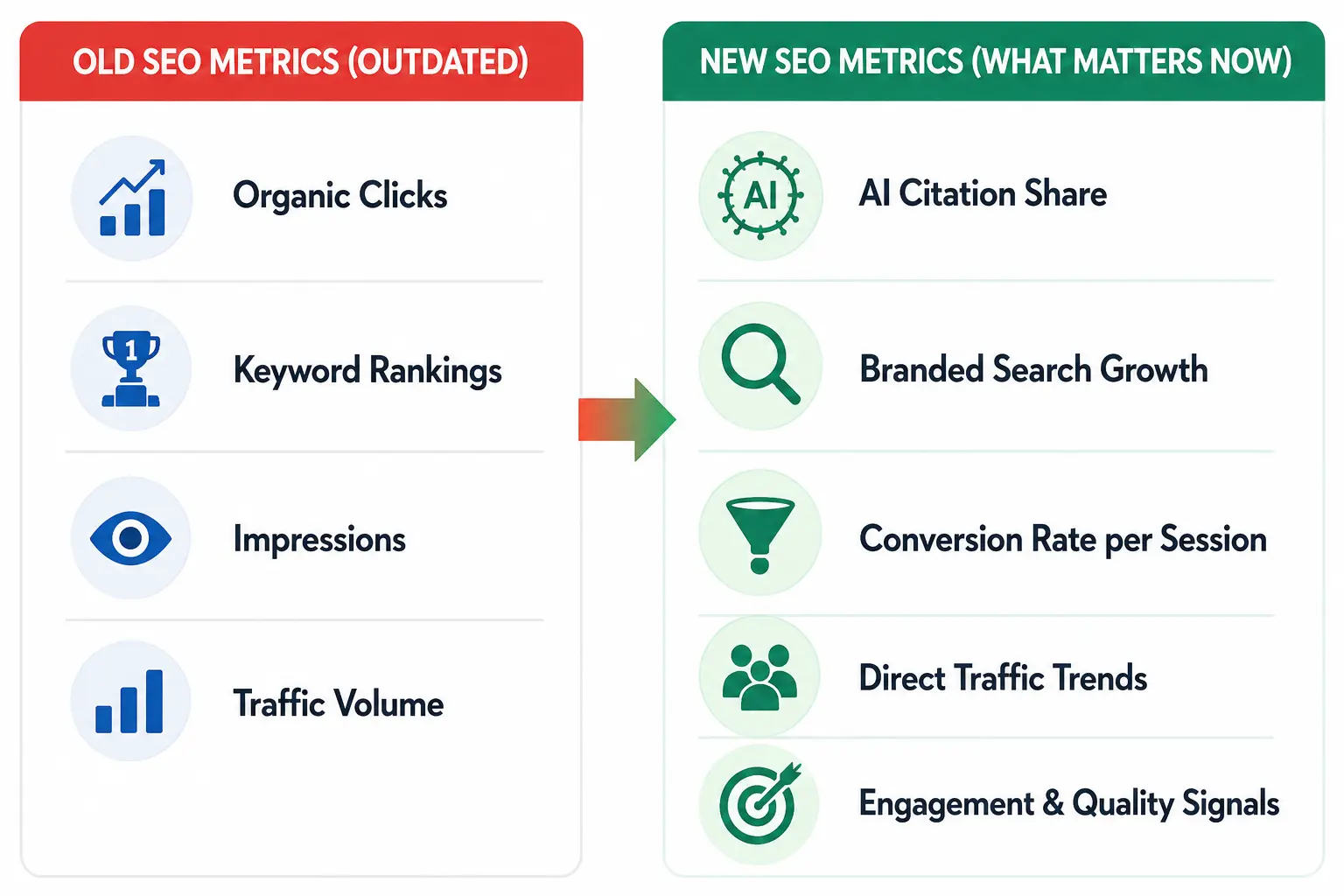
One of the underrated problems right now is that most businesses are still measuring SEO performance the way they did in 2020. Those old metrics are not lying they are just telling an incomplete story.
Here is the practical shift:
Organic clicks alone no longer captures the full picture. AI Overviews reduce clicks without reducing brand visibility or influence. A user can see your brand cited in three AI answers in one day and never click your site, but they are building awareness of your business.
Keyword rankings at position #1 mean less when an AI Overview sits above the entire page. You can rank first and still earn far fewer clicks than before.
What to track instead:
- AI citation share — how often your brand appears inside AI-generated answers for your target topics
- Branded search growth — if people are searching your business name directly, that signals growing trust
- Conversion rate per session — AI-referred visitors tend to be further along in their decision-making and convert at higher rates
- Direct traffic trends — a measure of how many people seek you out without needing a search engine
Demand Local’s analysis (2026) put it clearly: most agency reporting is now misaligned with how value is actually created. Sessions and rankings undercount AI-cited brands. The metrics that matter in 2026 are click quality, citation share, conversion per session, and assisted pipeline.
What SEO Looks Like for Businesses Right Now
If you run a business and you are trying to understand what to actually do, here is the practical picture.
Service and product pages are still your most valuable SEO real estate. Google does not replace commercial intent pages with AI Overviews at the same rate it replaces informational blog posts. A person searching “SEO agency for manufacturing companies” or “local SEO services near me” is looking for a business, not a summary.
Local SEO matters more, not less. Local searches still drive real foot traffic and phone calls. Google Business Profile, location-specific landing pages, and local citations remain strong channels.
Topical authority beats individual blog posts. Instead of publishing one article on a broad topic, build a cluster of content that covers a subject from multiple angles. Google and AI systems both reward sources that demonstrate consistent, deep knowledge in a specific area.
Technical SEO is the foundation on which everything else depends. Fast load times, mobile performance, crawlability, and structured data; these factors have not become less important. If AI systems cannot access and parse your content cleanly, they cannot cite it.
Brand presence off-site feeds AI systems. Mentions on Reddit, YouTube, industry publications, and niche forums all contribute to the signals that AI tools use to determine whether your brand is a credible source. This is not traditional link building; it is visibility across the platforms where people actually discuss topics.
Businesses that treat SEO as a trust-building exercise across all these channels are gaining ground right now. Businesses that stopped investing in organic search because of the current noise are quietly handing market share to competitors who kept going.
“SEO is Dead” Has Been Wrong Before
Let’s put this in context with a quick timeline:
2011 — Google Panda penalized thin, low-quality content. Practitioners who focused on depth adapted and came out stronger.
2012 — Google Penguin targeted manipulative link schemes. Businesses that built real authority survived.
2015 — Mobile-first indexing changed how Google evaluated sites. Sites that optimized for mobile gained ground.
2017 — Featured Snippets introduced the first wave of zero-click concern. Publishers who structured content for snippets captured more visibility, not less.
2019 — BERT improved Google’s natural language understanding. Content written for actual readers, not keyword density, performed better.
2023 — Helpful Content Update penalized mass-produced, purposeless content. Original, experience-backed writing pulled ahead.
2024–2025 — AI Overviews and ChatGPT. SEO is adapting again.
2026 — March & May Core Updates. Google tightened its evaluation of content quality, authorship, and E-E-A-T signals. Sites with transparent credentials and verifiable sources held rankings. Everything built on thin content or AI spam dropped.
The pattern is consistent. Every time a major shift happens, practitioners who adapt early gain an advantage. The ones who declare SEO dead simply stop showing up, and their competitors quietly take their rankings.
What to Do Right Now
If you want a practical starting point, here is where to focus:
1. Audit your existing content. Identify which pages rely on informational queries and which serve commercial intent. The informational ones need restructuring. The commercial ones need strengthening.
2. Update your top-performing pages. Recency is a real factor in AI citations. Pages that have not been touched in two or three years are losing ground to fresher content covering the same topic.
3. Structure content to answer questions directly. Put the core answer in the first paragraph. Then expand. This is what AI systems extract, and it is what readers on a phone skimming for a quick answer actually want.
4. Add real author signals. A byline with credentials, a linked author bio, and first-hand experience in the content itself are the signals Google’s E-E-A-T guidelines reward.
5. Build structured data into your pages. Schema markup helps both Google and AI systems understand what your page is about and extract the right information.
6. Stop tracking only clicks and rankings. Start tracking branded search growth, AI citation presence, and conversion quality alongside traditional metrics.
7. Do not abandon SEO, extend it. The goal has not changed: be the most trusted, visible, and useful source in your space. The channels and tactics to get there have.
If you need a clear roadmap for your specific business, the SEO team at Vinzotech builds strategies around exactly this kind of adapted approach, not the playbook from 2019, but the one that works now.
FAQs
Yes. SEO is still one of the highest-returning digital marketing channels for businesses. Transactional and local searches, the kind that drive actual revenue, are largely unaffected by AI Overviews. What has changed is the strategy, not the value of being visible in search.
Not entirely. AI Overviews reduced clicks on informational queries significantly, studies show CTR dropped up to 61% for those searches. But commercial and transactional searches remain strong. The businesses hurt most were those depending on high-volume blog traffic rather than service or product pages.
No, but the approach needs to change. Generic, thin blog posts built purely for traffic no longer work. Content that shows real expertise, answers specific questions, and builds topical authority still performs well and gets cited by AI tools, which creates a new kind of visibility.
Not yet, and not at the scale most people assume. Google processes over 14 billion searches per day. ChatGPT handles around 37 million. AI tools are absorbing quick informational queries, but Google still dominates commercial and local search by a massive margin.
GEO stands for Generative Engine Optimization. SEO focuses on ranking in traditional search results. GEO focuses on getting your content cited inside AI-generated answers on platforms like ChatGPT, Gemini, and Google AI Overviews. The two strategies share the same foundation: quality content and genuine authority, but GEO adds extra emphasis on structured answers, fresh content, and brand presence across multiple platforms.
Focus on clear, structured content that answers specific questions directly. Use schema markup, keep your pages updated regularly, add real author credentials, and cite credible sources within your content. Sites that rank organically are also the most likely to get cited in AI Overviews. The two goals support each other.
SEO works particularly well for small businesses through local SEO, Google Business Profile optimization, location-specific landing pages, and local citations. These areas are less competitive than national keywords and directly connect to high-intent customers looking for services nearby.
Get a second opinion. SEO has changed significantly, but abandoning it entirely in favor of paid ads alone means paying for every visitor indefinitely with no compounding return. A good strategy uses both SEO to build long-term authority and organic visibility while paid ads deliver immediate results. Any agency writing off SEO entirely is either misinformed or steering you toward a higher-margin service.
Last Words!
SEO is not dead. But the old version of it built on volume, keyword density, and gaming position #1 is no longer enough.
The businesses winning in search right now are not doing less SEO. They are doing better SEO, extended into the AI-driven reality of how people actually find information today.
The question was never really “Is SEO dead?” The real question is whether your SEO strategy has kept up with where search actually is.
At Vinzotech, we help businesses build search visibility that holds up not just against algorithm updates, but across the new AI-driven search environment. The strategy has changed. The goal has not.