

You generate HVAC leads without paid ads by combining local SEO, a properly optimized Google Business Profile, service-specific content built around what homeowners actually search for, a steady flow of reviews, referral systems built on your past customers, and content structured well enough that AI tools like ChatGPT and Google’s AI Overviews start recommending you. None of these replace paid ads overnight. But together, they build something ads can’t: a lead source that keeps working after you stop paying for it.
That distinction matters more this year than it did a few years ago. Cost per lead for HVAC marketing now runs $70 to $150, and in competitive metro markets it can climb past $250 per lead. Pay that every month, forever, and the math starts to look uncomfortable, especially for smaller shops running two or three trucks. Organic channels take longer to build but don’t disappear the day you pause your budget.
This article guides through each of those channels in enough detail that you can actually start using them this week, not just understand them in theory.
Why HVAC Businesses Are Rethinking Paid-Ad-Only Lead Generation
Paid search has always been a fast way to get in front of someone searching “AC repair near me” at 2 pm on a 100-degree day. That urgency is exactly why it’s expensive. You’re bidding against every other contractor in your area who wants that same click, and during peak season, that bidding war gets brutal.
AC repair search volume jumps roughly 266% in July compared to baseline months. Furnace repair searches spike about 137% above baseline in January (HVAC Industry Statistics 2026). Ad costs rise right along with that demand, because every contractor in your market is fighting for the same clicks at the exact moment homeowners are searching hardest. If your lead generation depends entirely on paid ads, your cost per acquisition swings wildly with the seasons, and you have almost no control over it.
There’s also a compounding problem with paid-only strategies: they don’t build anything. Turn off the budget and the leads stop the same day. A blog post that ranks for “why is my AC blowing warm air” keeps bringing in traffic eighteen months later without another dollar spent on it. That’s the real argument for organic channels. It’s not that they’re free. It’s that they keep paying you back long after the work is done.
One more number worth sitting with: the average lifetime value of an HVAC customer is around $15,340, against an acquisition cost of roughly $296 to $350 per customer. (2025 HVAC Industry Report) When you look at those numbers side by side, even a handful of organic leads a month, built through SEO and reviews instead of ad spend, adds up to real money saved over a year.
Start With Local SEO – The Foundation of Free HVAC Leads
Why Local Search Is Where HVAC Decisions Actually Happen
Most HVAC calls start with a problem, not brand loyalty. Someone’s furnace stops working on a cold morning and they open Google. They’re not thinking about which company has the best branding. They’re looking at whoever shows up first in the map pack with decent reviews and a phone number they can tap immediately.
That’s why local search visibility matters more for HVAC than almost any other type of content. You’re not trying to win someone over with a clever campaign. You’re trying to be the obvious, trustworthy option the moment they need you.
Optimize Your Google Business Profile Properly
This is the single highest-leverage thing most HVAC companies get wrong, usually by accident rather than neglect. A few things worth checking today:
- Your primary and secondary categories should reflect exactly what you do (HVAC contractor, air conditioning repair service, furnace repair service) rather than a generic “contractor” label.
- Your service list should match what you actually offer, updated as your business changes.
- Photos should show your actual trucks, technicians, and completed jobs, not stock imagery. Homeowners can tell the difference, and so can Google.
- Your name, address, and phone number need to be identical across every directory listing you have. Even small inconsistencies confuse both customers and search engines.
A mistake I see constantly: businesses create a separate Google Business Profile for every neighborhood or suburb they service, thinking it’ll help them rank locally. It usually backfires. Duplicate listings split your review count and ranking signal across multiple profiles instead of building one strong one. One well-maintained profile for your primary location, supported by service-area pages on your website, works better almost every time.
Build Dedicated Pages for Each Service, Not One Generic “Services” Page
A single “Our Services” page listing AC repair, furnace installation, heat pump service, and emergency HVAC in one paragraph is competing for nothing in particular. Google has no clear signal about what that page should rank for, and neither does the homeowner scanning it on their phone.
Dedicated pages solve that. An AC repair page built around AC repair searches. A furnace installation page built around furnace installation searches. Each one answering the specific questions someone in that situation actually has. This is the kind of structural work that a properly built HVAC SEO strategy is built around, and it’s usually the difference between a website that generates calls and one that just sits there looking professional.
Reviews matter here too, arguably more than most contractors assume. Ninety-one percent of consumers rely on online reviews when choosing an HVAC contractor, and that number shows up everywhere in industry research. Which brings us to the next channel.
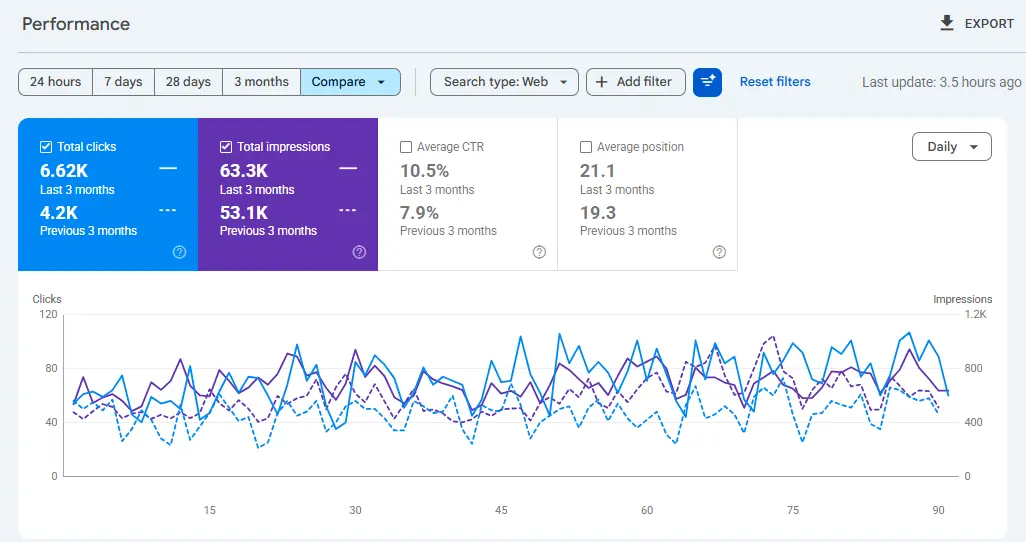
3-Month Google Search Console Growth for One of Our HVAC Client
The comparison below highlights three months of organic search performance for one of our HVAC clients. It shows how consistent SEO improvements can increase search impressions, clicks, and overall visibility. Every business starts from a different position, so results vary based on competition, website condition, and the SEO strategy implemented.
Turn Reviews Into a Lead Generation Channel
Why Reviews Influence the Click More Than Rank Position
Rank position gets you in front of someone. Reviews are what get them to actually click your listing instead of the one two spots below yours. Homeowners scan the star rating and review count before they read a single word of your description.
Nearly 74% of consumers made their HVAC purchase after checking at least one review site first. And reliability, not price, is the top priority for 38% of consumers choosing a contractor. Reviews are the fastest way homeowners judge reliability before they’ve ever spoken to you.
A Simple System for Getting More Reviews Without Being Pushy
The timing matters more than most people think. Send the review request within an hour of the job being completed, while the technician’s work is still fresh and the relief of a fixed furnace is still fresh too. Wait two weeks and that satisfaction has faded into the background of someone’s regular life.
Automating this through your field service software removes the awkwardness of a technician having to ask in person. A short text with a direct link works better than an email most of the time, simply because people respond to texts faster.
One common mistake: only requesting reviews after big installs and ignoring the smaller repair calls that make up most of a typical week. Those smaller jobs are still opportunities. A homeowner whose AC you fixed for $300 is just as likely to leave a glowing review as one who spent $8,000 on a new system, and there are usually a lot more of those smaller jobs happening.
Create Content That Answers What Homeowners Are Actually Searching
Match Content to the HVAC Search Calendar
HVAC search behavior follows the weather closely. AC-related searches climb through spring and peak in summer. Furnace and heating searches climb through fall and peak in winter. If you’re publishing or refreshing content, doing it ahead of that curve, AC content in March and April, heating content in September and October, gives Google time to index and rank it before the demand spike actually hits.
Answer Specific Questions, Not Broad Topics
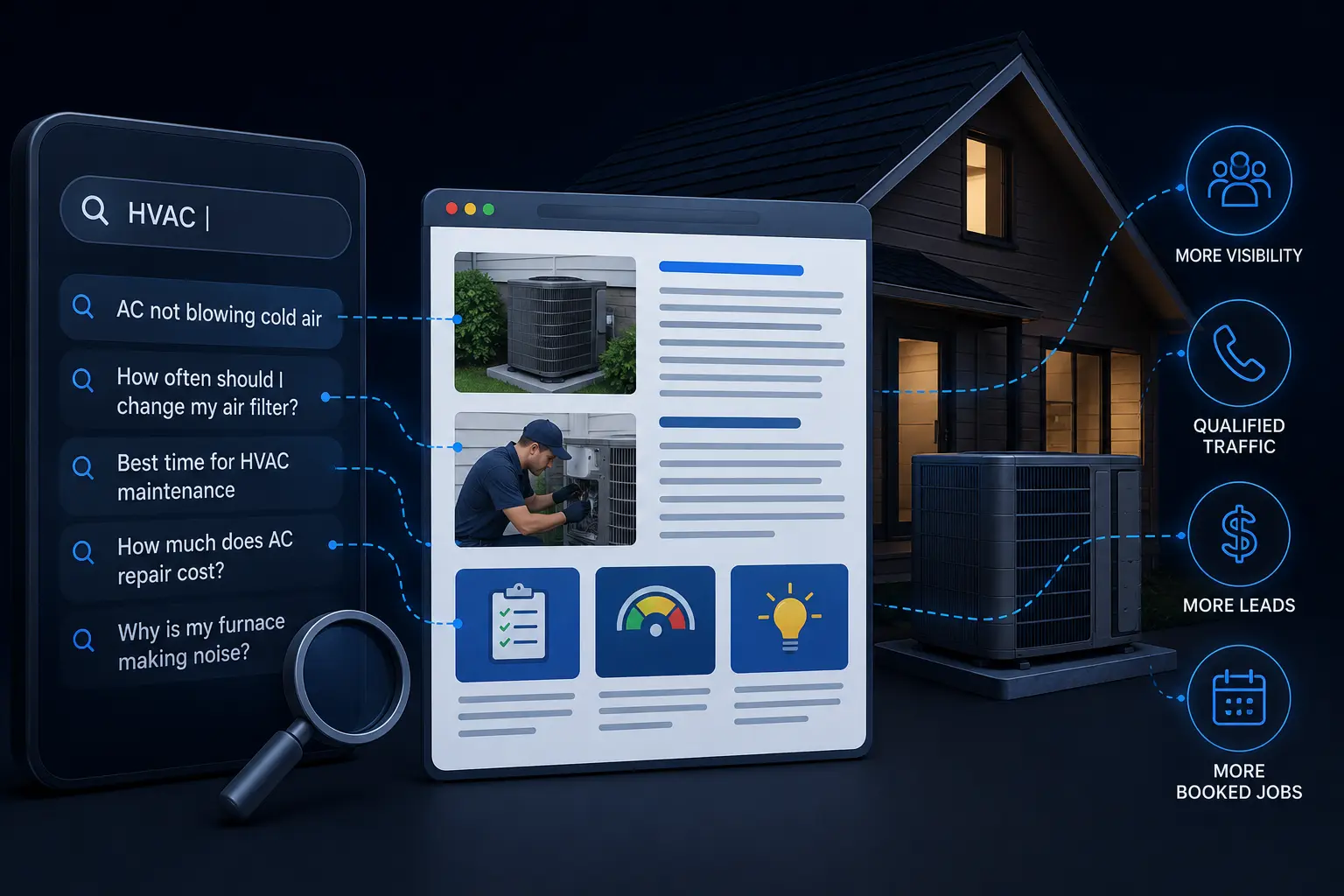
Broad terms like “hvac company” are crowded and expensive to compete for. Specific questions are where the real opportunity sits: “why is my AC blowing warm air,” “is it cheaper to repair or replace my furnace,” “how much does it cost to fix a broken compressor.” These get searched by someone actively trying to solve a problem right now, which usually means they’re closer to picking up the phone than someone typing a generic industry term.
Write for Featured Snippets and AI Overviews
Answer the main question in the first two or three sentences of any page or post you publish. Don’t build up to it. This format is exactly what gets pulled into Google’s featured snippets and AI Overviews, and it’s also what gets quoted directly when someone asks ChatGPT or Perplexity to recommend a local contractor.
This part of the strategy has changed fast. A 2026 BrightLocal survey found 45% of consumers now use AI tools to find local services, up from just 6% a year before that. And the traffic from those AI recommendations isn’t just bigger, it converts better too. Semrush data shows AI-referred traffic converts at roughly 4.4 times the rate of standard search traffic, likely because the homeowner has already done most of their research and decision-making before they ever call you.
Use AI Lead Generation for HVAC the Right Way
What AI Lead Generation Actually Means for a Local Business
There’s a lot of confusion around what “AI lead generation” means for a company that installs furnaces and fixes air conditioners. It’s not primarily about chatbots. It’s about whether AI tools have enough clear, structured information about your business to recommend you when someone asks for a contractor recommendation.
That comes down to two things: consistent information across your website and directories, and structured data (schema markup for your business, your services, and your service area) that helps AI systems understand exactly what you do and where you do it. This is closer to generative engine optimization than traditional advertising, and it’s becoming a real factor in where leads originate.
Practical Ways to Show Up in AI Answers
Keep your business information, hours, service area, and phone number identical across your website, Google Business Profile, and every directory you’re listed on. AI tools cross-reference multiple sources, and conflicting information reduces the odds you’re the one they recommend.
Publish clear, well-structured service pages and answer specific homeowner questions directly rather than burying the answer in marketing language. This is the same content that gets cited when someone asks an AI tool “who’s a good HVAC company near me.”
A mistake worth calling out: some contractors chase AI-specific tactics while ignoring the basics, review volume and NAP consistency, that AI tools also weigh heavily when deciding who to recommend. The fundamentals still carry most of the weight.
Where AI Chat Widgets Can Help (and Where They Don’t)
An AI chat or booking widget on your site can capture after-hours leads that would otherwise leave without contacting you. It’s genuinely useful for that. But it only converts traffic that’s already arriving. It doesn’t create visibility on its own, so treat it as a conversion tool layered on top of the visibility work above, not a replacement for it.
Missed-call text-back tools solve a related and often bigger leak: the calls that ring through after hours and never get returned. For a small team, this alone can recover leads that would otherwise just go to the next name on the homeowner’s search results.
Build a Referral and Repeat-Customer Engine
Why Past Customers Are the Cheapest Leads You’ll Ever Get
Database marketing to past customers returns roughly $8 to $12 for every dollar spent, compared to $3 to $4 per dollar for acquiring a brand-new customer. That gap exists because past customers already trust you. You’re not starting from zero the way you are with a stranger who found you through a Google search.
Practical Referral Tactics That Work for HVAC
Seasonal maintenance reminders paired with a small referral incentive tend to work better than a generic “refer a friend” campaign that sits unused in a customer’s inbox. The simplest version costs nothing: at the end of a service call, ask the homeowner directly if they know a neighbor who might need similar work.
Maintenance agreements do double duty here, keeping customers engaged and dramatically improving your replacement close rate. Replacement close rates for customers on a maintenance agreement run 65% to 75%, compared to 25% to 35% for customers without one. That’s not a small difference. It’s close to triple the conversion rate on the highest-value jobs you sell.
A common mistake is treating the customer database as a one-time transaction record instead of an ongoing channel. The names in that database are worth actively marketing to, not just storing.
Compare the Most Effective HVAC Lead Generation Channels
Not every lead generation strategy works the same way. Some deliver results quickly but require ongoing spending, while others take longer to build and continue generating enquiries over time. The comparison below highlights how each channel supports HVAC business growth.
| Lead Generation Channel | Time to See Results | Ongoing Cost | Best For | Long-Term Value |
| Local SEO | 3–6 months | Low | Consistent organic leads | ⭐⭐⭐⭐⭐ |
| Google Business Profile | 2–8 weeks | Low | Local searches and Google Maps | ⭐⭐⭐⭐⭐ |
| Paid Google Ads | Immediate | High | Emergency and seasonal demand | ⭐⭐☆☆☆ |
| Content Marketing | 3–9 months | Low to Medium | Building long-term traffic | ⭐⭐⭐⭐⭐ |
| Customer Reviews | 1–3 months | Low | Building trust and improving conversions | ⭐⭐⭐⭐☆ |
| Referral Marketing | Ongoing | Low | Repeat business and local referrals | ⭐⭐⭐⭐☆ |
| AI Search Visibility | 3–6 months | Low | AI Overviews and AI assistants | ⭐⭐⭐⭐☆ |
Tip: The strongest HVAC marketing strategy combines several of these channels instead of relying on one source of leads. Local SEO, Google Business Profile optimization, customer reviews, and helpful content work together to build a steady flow of qualified enquiries.
Partner With Local Businesses and Community Sources
Real Estate Agents, Property Managers, and Home Inspectors
These groups run into HVAC problems constantly, aging systems flagged during a home inspection, tenants reporting a broken furnace, a property manager needing a reliable vendor for multiple units. A simple conversation with three to five local agents or inspectors, without any formal contract, can turn into a steady trickle of warm referrals over time.
Local Sponsorships and Community Visibility
Sponsoring a local youth sports team or community event puts your name in front of the same households you’re targeting with local SEO. The two reinforce each other. Someone who’s seen your logo at their kid’s soccer game is more likely to click your listing over a stranger’s when they’re scanning search results later.
Fix the Leaks Before Adding More Lead Sources
Common Mistakes That Waste Leads You Already Have
Before adding a new channel, it’s worth checking whether you’re losing leads you’re already generating. Slowness or unresponsiveness accounts for 55% of negative HVAC customer reviews, more than any other complaint category. That’s often a faster, cheaper fix than any new marketing channel: answer the phone faster, follow up on missed calls the same day, and confirm appointments instead of leaving homeowners guessing.
Inconsistent business listings across directories, no missed-call text-back system, and ignoring smaller repair jobs when asking for reviews are the other recurring leaks I see across HVAC businesses of every size.
A Simple Way to Audit Your Current Lead Flow
Track where every lead comes from for 30 days: which calls came from Google, which came from a referral, which came from your website’s contact form. Most HVAC businesses discover at least one channel that’s already producing decent results but getting almost no attention or investment, rather than needing an entirely new strategy bolted on top.
Building a Lead Generation System That Doesn’t Depend on Ad Spend
The channels that work best together are the ones covered here: a solid local SEO foundation, a steady flow of reviews, seasonal content built around what homeowners actually search, structured information that AI tools can confidently recommend, a referral system built on your existing customers, and fast follow-up so you’re not losing the leads you already have.
None of this replaces paid ads entirely, and for some businesses a mix of both makes sense. But these channels compound. A review earned this month keeps influencing clicks for years. A well-built service page keeps ranking long after you’ve stopped thinking about it. Paid ads stop the moment the budget does.
For HVAC companies without the in-house time or SEO experience to build this out themselves, working with a dedicated SEO services team can shorten the timeline considerably. That’s a large part of what VinzoTech works on with contractors: building the local SEO, content, and review systems that keep generating calls long after any single campaign ends.
FAQs on HVAC Lead Generation
HVAC lead generation is the process of attracting homeowners and businesses looking for heating, ventilation, and air conditioning services. It includes strategies such as local SEO, Google Business Profile optimization, content marketing, customer reviews, referrals, email marketing, and paid advertising to generate enquiries and booked jobs.
You can generate HVAC leads through local SEO, an optimized Google Business Profile, service-specific landing pages, customer reviews, referral programs, helpful blog content, and strong local citations. These strategies take time to build but can continue generating leads without paying for every click.
Yes. Local SEO helps your business appear when people search for HVAC services in your service area. Optimizing your website, Google Business Profile, location pages, and customer reviews can improve your visibility in Google Search and Google Maps, leading to more qualified enquiries.
Paid advertising can produce leads quickly, especially during peak heating and cooling seasons. For long-term growth, combining paid ads with local SEO, customer reviews, and content marketing provides a more stable source of qualified leads.
There isn’t a single strategy that works for every business. Many successful HVAC companies combine local SEO, Google Business Profile optimization, customer reviews, referral marketing, and seasonal content with paid advertising to maintain a consistent flow of enquiries throughout the year.
Google Business Profile is one of the most important local marketing tools for HVAC companies. A complete and regularly updated profile can improve visibility in Google Maps, increase phone calls, and help customers find your business when they need heating or cooling services.
Common reasons include poor local search visibility, slow page speed, weak service pages, limited location-specific content, outdated Google Business Profile information, or a lack of customer reviews. A website audit can help identify the issues that are affecting performance.
SEO is a long-term investment. Many businesses notice improvements within three to six months, while highly competitive markets may require additional time. Results depend on factors such as competition, website quality, service areas, and the consistency of SEO efforts.
If you don’t have the time or expertise to manage SEO, local search, content, and lead tracking, working with an HVAC lead generation agency can help. Look for an agency with experience in local SEO, transparent reporting, and a strategy tailored to your business goals rather than one that promises instant rankings.
Ready to Generate More HVAC Leads?
Every HVAC business has opportunities to improve its local search visibility. If you’re ready to attract more qualified enquiries, we’ll review your website, identify missed opportunities, and recommend an SEO strategy based on your services, service areas, and business goals.