
Key Takeaways
- Optimize your Google Business Profile with complete and accurate business information.
- Target location-specific keywords that match what potential customers are searching for.
- Create useful location and service pages instead of duplicate content.
- Collect genuine customer reviews and respond to feedback.
- Build relevant local backlinks and maintain consistent business listings.
- Improve website performance, mobile usability, and local content.
- Track calls, enquiries, website traffic, and other meaningful results.
Running a small business means competing for attention, often against companies with bigger marketing budgets and more established online reputations. But a business does not need to be the biggest in its industry to attract customers from its local area. It needs to be visible when people search for the products or services it offers.
This is where local SEO becomes important.
When someone searches for a plumber near them, a roofing company in their city, or a nearby restaurant, Google displays results that help them find relevant businesses. If your business does not appear in these searches, potential customers may choose a competitor instead.
So, what are the best local SEO strategies for small businesses? The answer involves more than creating a Google Business Profile or adding a few location-based keywords to your website. It requires a consistent approach to local visibility, website optimization, customer reviews, and online reputation.
Let’s look at nine practical strategies small businesses can use to improve their local search presence and attract more relevant enquiries.
Why Does Local SEO Matter for Small Businesses?
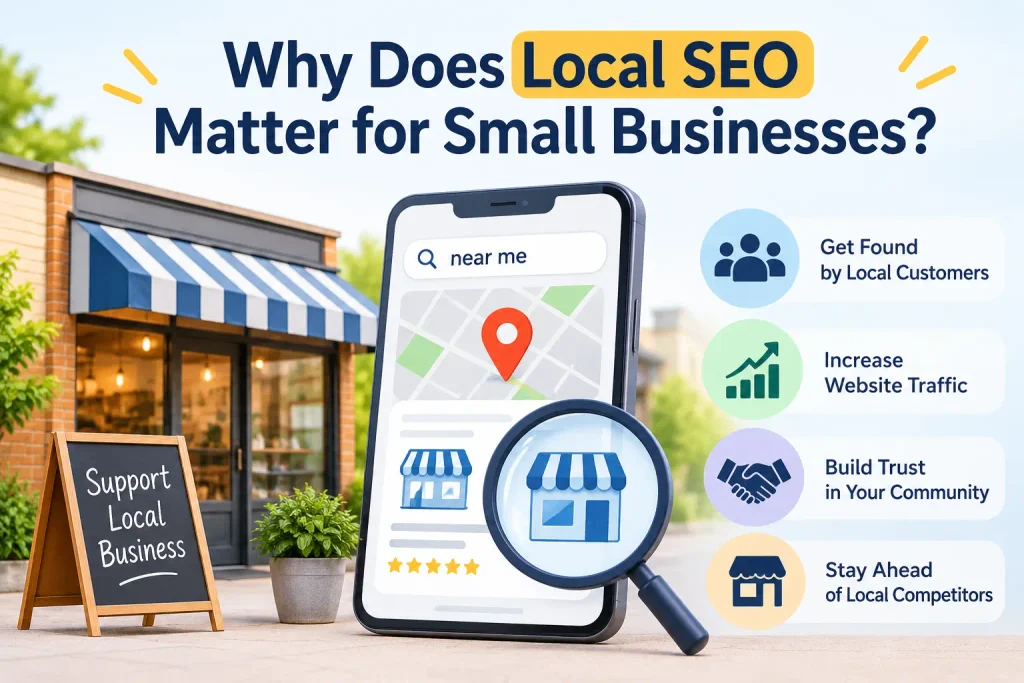
Local SEO helps businesses appear in search results when people look for products or services in a particular location. It connects businesses with customers who are actively researching nearby options.
Consider a homeowner searching for an emergency plumbing service. They are unlikely to browse dozens of websites. They want to find a reliable business that serves their area and can respond to their needs.
A business with accurate contact details, helpful service pages, genuine reviews, and a well-maintained Google Business Profile has a better opportunity to attract that customer.
Recent research also highlights the importance of local visibility. According to BrightLocal’s consumer search behavior research, 84% of US consumers had searched for a local business online in the previous three months. Its research also found that 72% of consumers considered three or fewer businesses before making a decision.
These findings show why appearing in local searches is important. Businesses need to be visible, but they also need to give customers enough information to feel confident contacting them.
9 Best Local SEO Strategies for Small Businesses
1. Optimize Your Google Business Profile
Your Google Business Profile is one of the most important parts of a local SEO strategy. It allows your business to appear in Google Maps and local search results when people search for relevant services.
Start by claiming and verifying your business profile. Then make sure all the information is accurate and complete.
Here are some important areas to focus on:
- Business name: Use your actual business name without adding unnecessary keywords.
- Business category: Select the most relevant primary category and appropriate additional categories.
- Business hours: Keep opening hours updated, including holiday hours.
- Services: Add the services your business genuinely offers.
- Description: Explain what your business does and who it serves.
- Photos: Upload genuine images of your team, workplace, products, or completed projects.
For example, a roofing contractor should clearly list roofing services, service areas, operating hours, and relevant project photos.
Do not treat your profile as a one-time setup. Review it regularly and update information whenever something changes.
Google explains that local search results are mainly influenced by relevance, distance, and prominence. Providing complete business information helps Google understand how your business relates to a search.
2. Target Location-Based Keywords
Using the right keywords helps search engines understand which services your business offers and where you provide them.
Instead of targeting broad terms such as “plumbing services” or “roofing company,” consider how customers search when they need a local provider.
For example:
- Plumber in Edison, NJ
- Roofing company in New Jersey
- Emergency plumbing services in Houston
- Local electrician in Dallas
Start with keyword research to identify relevant search terms, their intent, and the locations your business actually serves.
You can use Google Keyword Planner, Google Search Console, and other keyword research tools to find opportunities.
Once you identify relevant keywords, include them naturally in:
- Page titles and meta descriptions.
- Main headings and subheadings.
- Service page content.
- Relevant location pages.
- Image alt text where appropriate.
Avoid repeating the same city or keyword throughout a page. Content should read naturally and answer the customer’s question.
A useful approach: Map one main search intent to each important page. For example, a page targeting “roof repair in Edison” should explain roof repair services in that area rather than trying to target every roofing-related keyword on one page.
3. Create Useful Local Landing Pages
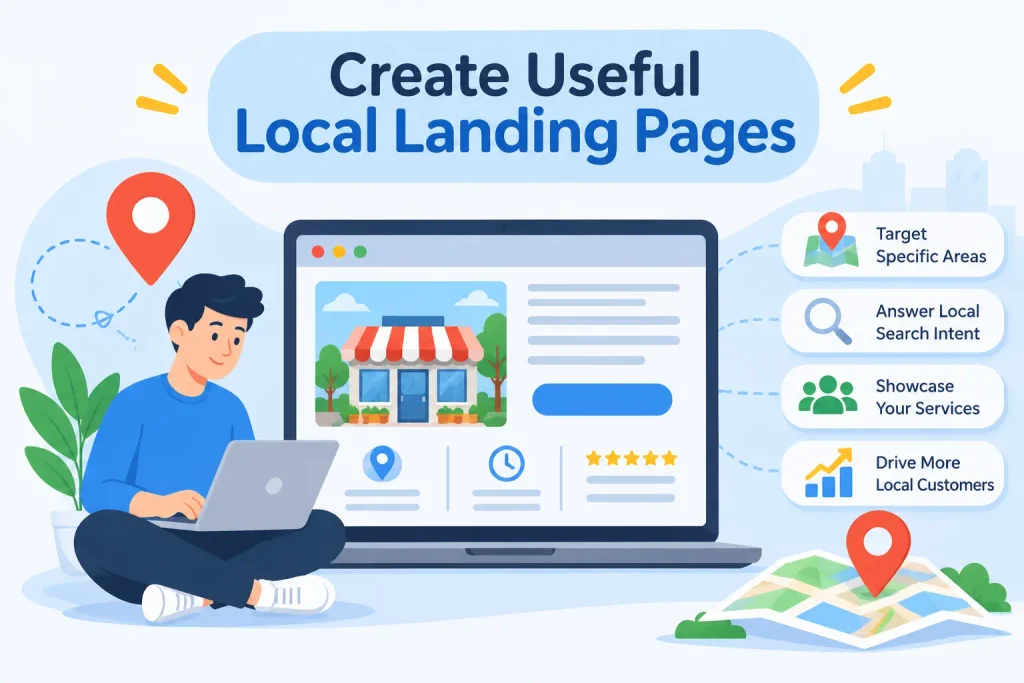
If your business serves multiple cities or neighborhoods, dedicated location pages can help customers understand where your services are available.
However, simply replacing a city name in the same paragraph and publishing multiple pages is not a good strategy.
Each location page should provide information that is genuinely useful to someone in that area.
Include:
- Services available in that location.
- Relevant information about the area you serve.
- Local customer questions and concerns.
- Genuine project examples or testimonials, where available.
- Accurate contact and service information.
- Links to related service pages.
For example, a home improvement company serving Edison and Woodbridge could create separate pages explaining the services available in each location, supported by relevant project information.
Avoid publishing pages for locations where you have no genuine service presence or creating repetitive doorway pages just to capture keyword variations.
The objective is to help visitors understand whether your business can meet their needs in their area.
4. Keep Your Business Listings Accurate and Consistent
Your business information should be consistent wherever customers find it online.
This includes your business name, address, phone number, website, and other important details.
Search for your business on relevant directories and review platforms. Check whether the information matches your official website and Google Business Profile.
Some practical steps include:
- Claim existing business listings.
- Correct outdated addresses and phone numbers.
- Remove duplicate listings where possible.
- Submit your business to relevant industry directories.
- Update information when your business details change.
For example, if your website displays one phone number but an important business directory shows an outdated number, customers may struggle to contact you.
Focus on trustworthy directories that are relevant to your industry and target market. Submitting your website to hundreds of unrelated directories is unlikely to provide meaningful value.
5. Collect Genuine Customer Reviews and Respond to Them
Customer reviews influence how people evaluate a business before making contact.
A potential customer comparing two local contractors may look at their ratings, review details, recent feedback, and the way each business responds.
Make it easy for satisfied customers to leave honest feedback. You can share your Google review link after completing a service or following a successful purchase.
When responding to reviews:
- Thank customers for positive feedback.
- Address negative experiences professionally.
- Avoid sharing private customer information.
- Take genuine complaints seriously.
- Never purchase fake reviews or manipulate ratings.
Reviews can also help businesses understand what customers appreciate and where improvements are needed.
BrightLocal’s consumer research found that only 6% of consumers simply clicked the top search result when researching a local business. Other factors, including location, star ratings, review counts, and complete listing information, influenced their decisions.
This is a useful reminder that search visibility alone does not guarantee that customers will choose your business.
6. Publish Helpful and Locally Relevant Content
Your website should answer the questions potential customers ask before choosing a business.
Instead of publishing general articles just to add more content, focus on topics connected to your services and customers’ needs.
For example:
A plumbing company could publish:
- What to Do When a Pipe Bursts in Your Home
- Common Plumbing Problems Homeowners Should Not Ignore
- How Often Should You Schedule Drain Cleaning?
A roofing company could cover:
- Signs Your Roof Needs Repair
- How to Prepare Your Roof for Storm Season
- Roof Repair vs. Roof Replacement: What Should You Choose?
Include local information when it genuinely adds value. This could involve local weather conditions, common property types, regional service requirements, or relevant project examples.
Use internal links to connect helpful blog posts with relevant service pages. This makes it easier for readers to explore your services and helps search engines discover related content.
Most importantly, write content that answers the question completely. A useful article should give readers practical information rather than simply directing them toward a sales enquiry.
7. Build Relevant Local Backlinks
Backlinks from other websites can help search engines understand the relationships between businesses, organizations, and online resources.
For small businesses, local link building should focus on genuine connections rather than collecting as many links as possible.
Consider these opportunities:
- Join relevant local business associations.
- Participate in community events.
- Sponsor local activities where appropriate.
- Contribute useful insights to local publications.
- Build partnerships with complementary businesses.
- Share original research or helpful resources that others may reference.
For example, a local home improvement company could earn a mention from a community organization after supporting a local renovation initiative.
The value comes from the relevance and credibility of the relationship, not simply the number of backlinks.
Avoid paid link schemes, irrelevant guest posts, and low-quality link exchanges. These approaches can create risks without providing lasting benefits.
8. Improve Website Speed, Mobile Experience, and Technical SEO
A well-optimized Google Business Profile cannot compensate for a website that is difficult to use.
Many customers discover local businesses while using their phones. They expect to find service information, contact details, and useful answers without struggling through slow-loading pages.
Review your website for the following issues:
- Does it work properly on mobile devices?
- Do important pages load quickly?
- Are contact details easy to find?
- Do buttons and forms work correctly?
- Are important pages indexed by Google?
- Are there broken links or unnecessary redirects?
- Is the website secured with HTTPS?
You should also use structured data where appropriate. Local Business schema can help search engines understand information such as your business name, address, contact details, and opening hours.
Make sure the structured data accurately reflects the visible information on your website. Adding schema does not guarantee rich results or higher rankings, but it can help search engines interpret business information.
9. Optimize for Voice and Conversational Local Searches
People do not always search using short keyword phrases. They also ask complete questions, especially when looking for nearby services.
For example, someone might search:
- Who provides emergency plumbing services near me?
- Which roofing company serves Edison, NJ?
- Where can I find an affordable electrician nearby?
Your website should make it easy for customers and search engines to understand what your business offers.
Consider adding useful FAQs to service pages, writing clear service descriptions, and answering common customer questions directly.
For example, a plumbing service page could answer:
- What plumbing services do you offer?
- Which areas do you serve?
- Do you handle emergency plumbing requests?
- How can customers schedule an appointment?
Use natural language rather than trying to insert every possible voice-search variation into your content.
As AI-powered search experiences continue to develop, clear business information and helpful, well-structured content can also make your website easier to understand across different search experiences.
How to Measure Local SEO Performance
Local SEO requires regular monitoring. Without tracking results, it becomes difficult to understand which activities are helping your business.
Start with Google Search Console to review organic clicks, impressions, search queries, and website performance.
Use Google Analytics 4 to understand website traffic, landing-page engagement, and enquiries.
You should also monitor Google Business Profile performance, including available customer interactions such as calls, website clicks, and direction requests.
Some important metrics include:
| Metric | What It Tells You |
| Local keyword rankings | How your website performs for location-based searches |
| Organic traffic | How many visitors reach your website through organic search |
| Google Business Profile interactions | How customers interact with your business listing |
| Calls and enquiries | Whether search visibility is generating potential customers |
| Conversions | How many visitors complete meaningful actions |
Do not judge your campaign by keyword rankings alone. A business may rank for several keywords but still receive few enquiries if its website lacks useful information or a clear contact process.
Common Local SEO Mistakes Small Businesses Should Avoid
Even a well-planned local SEO campaign can struggle when basic mistakes are overlooked.
Watch out for these common problems:
- Keyword stuffing: Repeating city names and search terms unnaturally makes content difficult to read.
- Duplicate location pages: Publishing nearly identical pages for multiple locations adds little value.
- Incomplete business profiles: Missing or outdated information can confuse potential customers.
- Ignoring customer reviews: Unanswered feedback can create a poor impression.
- Low-quality backlinks: Irrelevant links and manipulative link schemes can create unnecessary risks.
- Neglecting mobile users: A difficult mobile experience can discourage potential customers from contacting you.
- Expecting immediate results: Local SEO requires ongoing work, monitoring, and improvements.
How Can Small Businesses Build a Consistent Local SEO Strategy?
You do not need to implement every strategy at once. Start with the areas that have the greatest impact on your current online presence.
A practical starting point is to audit your website and Google Business Profile, identify the most important service and location keywords, and correct inaccurate business information.
Next, improve your main service pages, collect genuine reviews, and publish useful content based on customer questions.
Finally, review your search performance regularly and make improvements based on actual results.
Consistency matters more than trying every new SEO tactic.
Frequently Asked Questions
The most useful strategies include optimizing your Google Business Profile, targeting relevant local keywords, creating helpful location pages, collecting genuine customer reviews, building relevant backlinks, and improving website performance.
Start by providing complete and accurate information on your Google Business Profile. Improve your website’s local relevance, build a trustworthy online reputation, and create useful content that matches customer searches.
Yes. Google Business Profile helps businesses appear in Google Maps and local search results. It also allows customers to view business information, services, photos, reviews, and contact details.
There is no fixed timeline. Results depend on competition, website condition, business history, location, and the work being implemented. Some improvements may appear within a few months, while competitive markets may require longer-term effort.
Start by identifying your main services and the locations you serve. Use keyword research tools such as Google Keyword Planner and Google Search Console to discover relevant search terms. Review customer questions and competitor content to understand what local customers are looking for
Target locations where your business genuinely operates or provides services. Start with your primary service area and expand when you can create useful, location-specific information for additional areas.
Yes. Local SEO can help small businesses reach customers searching for specific services in their area. A well-maintained business profile, relevant website content, positive customer reviews, and strong local relevance can help smaller businesses compete for local visibility.
Businesses should review their profiles regularly and update them whenever important information changes, such as opening hours, services, contact details, or business locations. Adding genuine photos and sharing relevant updates can also help keep the profile useful for customers.
Local citations are online mentions of your business information, such as its name, address, and phone number. They can appear on business directories, industry websites, local publications, and other relevant platforms. Accurate citations help customers find consistent business information.
Only create separate location pages when each page provides useful, location-specific information. Include relevant services, local project examples, customer questions, and service details. Avoid publishing multiple pages with nearly identical content and only changing the city name.
Final Thoughts
Local SEO is not about getting your business in front of everyone. It is about making it easier for nearby customers to find you when they are actively looking for the products or services you offer.
For small businesses, this starts with a few important steps: keeping your business information accurate, creating useful website content, collecting genuine customer reviews, and maintaining a consistent online presence. You do not need to do everything at once. Start with the areas that need the most attention, track your progress, and keep improving based on what works.
If you want to build a stronger local presence but are unsure where to start, VinzoTech can help you understand where your website stands and what needs improvement. Explore our SEO services to learn how a structured SEO strategy can improve your website’s search visibility and help your business connect with more potential customers.
Help More Local Customers Find Your Business
Find out how your business performs in local search. Get expert insights into your website, Google Business Profile, and local SEO opportunities to reach more nearby customers.
Get Your Free SEO Consultation