
Search is changing. People are no longer relying only on traditional search results to find information, compare businesses, or decide which service provider to contact. They are increasingly using conversational search experiences and AI-powered tools to ask questions and receive direct answers. This shift has made AEO vs SEO an important topic for businesses investing in online visibility.
The change shows up in real behavior. A Pew Research Center study that tracked the browsing of 900 U.S. adults found that users clicked a traditional search result in just 8% of searches with an AI summary, nearly half the 15% click rate on pages without one. The same study found that 60% of searches beginning with question words such as “who,” “what,” or “why” produced an AI summary. In other words, the more your customers ask full questions, the more likely they are to see an answer before they ever reach a website.
So, what is AEO vs SEO, and how does it differ from traditional SEO? SEO (Search Engine Optimization) focuses on improving a website’s visibility in organic search results, while AEO (Answer Engine Optimization) focuses on creating content that clearly answers questions and can be understood and surfaced by answer-driven search experiences.
Understanding SEO vs AEO doesn’t mean choosing one over the other. For many businesses, the better approach is to build a strong SEO foundation while also creating content designed to answer the questions customers are asking.
In this guide, we’ll explain the similarities and differences between AEO and SEO, compare their tools, explore their role in B2B lead generation, and explain how businesses can use both strategies together..
What Is AEO vs SEO?
SEO and AEO have overlapping foundations, but they focus on different search experiences.
What Is SEO?
Search Engine Optimization is the process of improving a website so that it can perform better in organic search results.
A business SEO strategy may include:
- Keyword research
- Search-intent analysis
- On-page optimization
- Technical SEO
- Internal linking
- Content marketing
- Backlink development
- Local SEO
- Competitor research
- Conversion optimization
For example, a New Jersey HVAC company may optimize a service page for searches such as “HVAC repair in New Jersey” or “emergency AC repair near me.”
The goal is to make the business easier to discover when potential customers use traditional search engines.
What Is AEO (Answer Engine Optimization)?
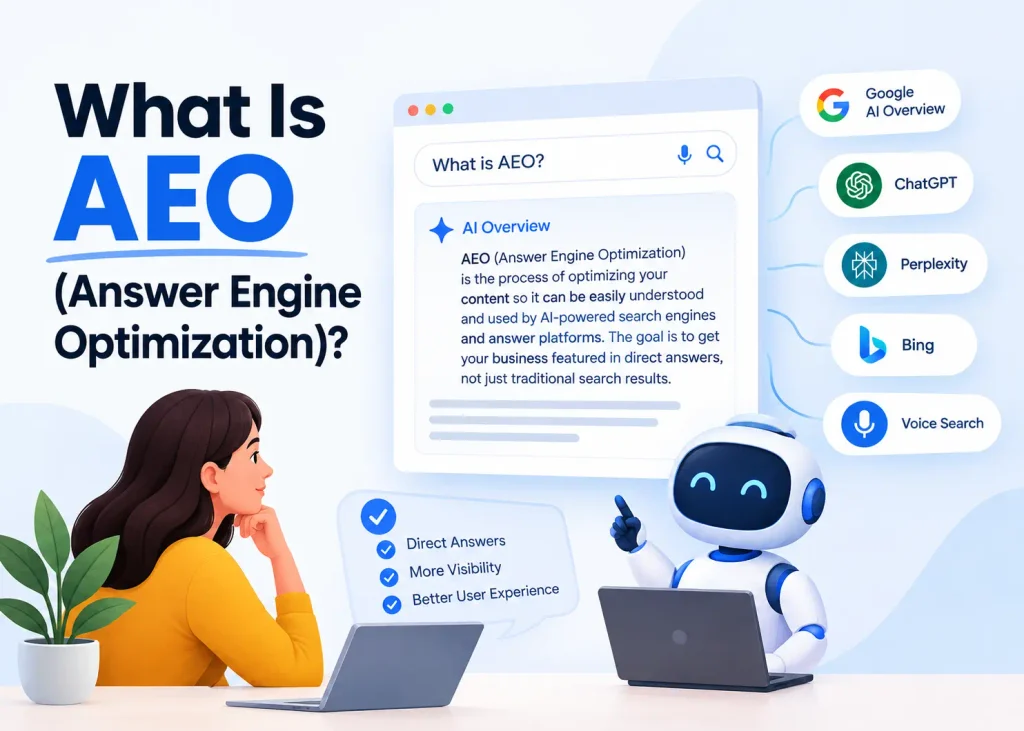
Answer Engine Optimization focuses on making information clear, useful, and understandable for answer-driven search experiences.
Instead of only targeting a phrase such as “B2B SEO agency,” an AEO strategy may also address questions such as:
- How does B2B SEO generate leads?
- How much does B2B SEO cost?
- What should a B2B SEO strategy include?
- How do I choose an SEO agency for my business?
AEO puts greater emphasis on questions, context, entities, concise explanations, structured information, and content that directly addresses customer needs.
For a business owner, the simplest way to think about it is:
SEO helps your business compete for organic search visibility. AEO helps your business prepare to be understood and surfaced in answer-driven search experiences.
SEO vs AEO — Key Similarities
The discussion around SEO vs AEO can make the two strategies sound completely separate. They aren’t.
A strong AEO strategy still benefits from many of the same fundamentals that support good SEO.
High-Quality Content
Both SEO and AEO depend on useful information.
If your website only repeats keywords without answering customer questions, it provides little value. Instead, create content that explains your products, services, processes, pricing considerations, comparisons, and solutions.
Strong Technical Foundations
Technical health matters because search systems need to access and understand your website.
Businesses should pay attention to:
- Crawlability
- Indexability
- Site architecture
- Internal links
- Mobile usability
- Page speed
- Clear navigation
Authority and Trust
Your website is only one part of your online presence.
Relevant industry publications, reviews, expert content, business profiles, case studies, and third-party references can all contribute to how customers and search systems understand your business.
That is particularly important for businesses competing in crowded U.S. markets where several companies may offer similar services.
Difference Between AEO and SEO
The biggest difference between AEO and SEO is what the optimization is trying to accomplish.
| SEO | AEO |
| Primarily focuses on organic search visibility | Focuses on answer-driven and AI search visibility |
| Often targets keywords and search intent | Emphasizes questions, context, entities, and natural language |
| Common goals include rankings, clicks, and organic traffic | Goals can include mentions, citations, and visibility in AI-generated answers |
| Uses technical SEO, content, internal linking, and authority-building | Uses clear answers, structured information, topical depth, and relevant context |
| Often encourages users to visit the website | May influence visibility even when the answer is provided directly in the search experience |
This does not mean that AEO guarantees an AI citation or that SEO only means ranking on Google. Modern search is more complicated than that.
For example, a page can rank well organically and still have limited visibility in a particular AI answer. Conversely, a business can be mentioned in an AI response based partly on information published outside its own website.
That’s why businesses should think about search visibility as a broader ecosystem rather than one ranking position.
AEO Tools vs SEO Tools – What You Need for Each
SEO Tools
SEO tools are designed to help businesses and marketers monitor, audit, and manage their website’s performance in traditional search.
Some widely used SEO tools include:
- Google Search Console – Provides data on Google Search visibility, indexing status, search impressions, clicks, and page performance.
- Google Analytics -Tracks website traffic, user behavior, engagement, and conversions.
- Semrush – Provides an all-in-one platform for monitoring SEO performance, competitors, backlinks, site health, and search visibility.
- Ahrefs – Offers tools for monitoring backlinks, website performance, competitors, and organic search visibility.
- Screaming Frog SEO Spider – Crawls websites to identify technical SEO issues and provides detailed website audit data.
AEO Tools
AEO tools are designed to help businesses monitor how their brands appear across AI-powered search and answer engines.
Some tools and platforms include:
- HubSpot AEO – Helps monitor brand mentions, citations, prompts, and visibility across AI search experiences.
- Semrush AI Visibility Toolkit – Provides AI visibility monitoring and insights into how brands appear across AI-generated search results.
- Ahrefs Brand Radar – Helps track brand visibility and mentions across AI search platforms.
- OtterlyAI – Monitors brand mentions, citations, and visibility across AI search platforms.
SEO Tools vs AEO Tools
The main difference comes down to where visibility is being measured.
SEO tools primarily help businesses monitor their presence and performance in traditional search engines, while AEO tools focus on how a brand appears in AI-powered search and answer experiences.
Using both types of tools gives businesses a broader view of their online search visibility-across both traditional search results and emerging AI search experiences.
What the Research Says About AI Search and Business Visibility
This isn’t just a theoretical change.
Semrush analyzed more than 600,000 keywords from its U.S. desktop database across 10 industries between November 2025 and April 2026. Its research found that the appearance of Google AI Overviews on commercial-intent search results increased by 71% over the six-month period.
For business owners, that matters because commercial-intent searches are often connected to researching products, services, providers, and purchasing decisions.
In other words, AI-generated answers are not limited to simple informational questions. They are increasingly appearing in search environments where businesses are competing for customers.
Semrush also found that AI Overviews and Google Ads were appearing together on search results roughly twice as often as the previous year during its study period.
That doesn’t mean every business should abandon traditional SEO. It suggests the opposite: businesses need to understand how their organic search strategy fits into a search environment that is becoming more answer-oriented.
AEO vs SEO for B2B Lead Generation
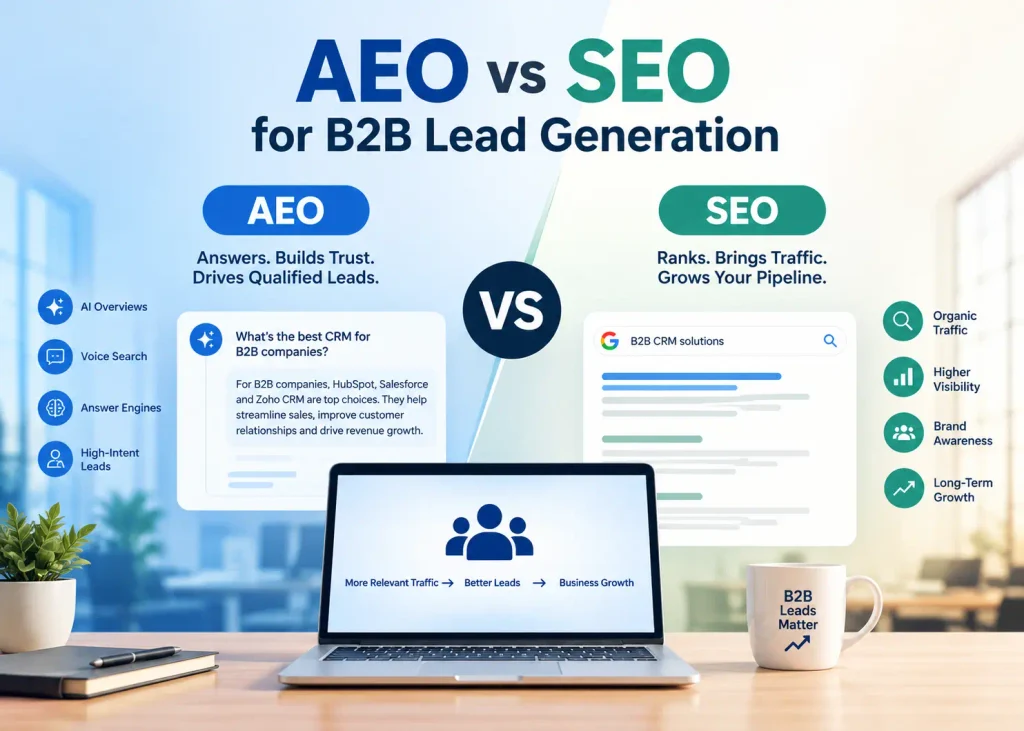
The relationship between AEO vs SEO for B2B lead generation is especially important for companies selling complex or high-value services.
A B2B buyer rarely searches once and immediately contacts a provider.
They may ask:
- What solution do I need?
- Which providers offer it?
- How much does it cost?
- What are the alternatives?
- Which solution is best for my industry?
- What should I consider before buying?
How AEO Can Support B2B Research
AEO gives businesses an opportunity to answer those questions directly through useful content.
For example, an American cybersecurity company could publish content covering:
“How much does managed cybersecurity cost for a small business?”
The article could explain pricing factors, service levels, implementation considerations, and common mistakes.
That content can educate a potential customer before they are ready to request a consultation.
Where SEO Still Drives B2B Leads
SEO remains important for high-intent pages such as:
- Service pages
- Product pages
- Industry pages
- Case studies
- Comparison pages
- Location pages
- Pricing pages
- Lead-generation landing pages
A combined approach can support the buyer journey:
Search → Answer → Research → Comparison → Website → Lead
For business owners, that’s the real value of combining AEO and SEO. You aren’t simply trying to generate more traffic. You’re trying to become visible at more points in the customer’s decision-making process.
Real-World Case Study: HubSpot’s AEO Strategy
In a case study updated in August 2026, HubSpot described how it began measuring AI visibility across ChatGPT, Gemini, Perplexity, and other answer engines. The company reported that its strategy included three major areas: on-site content optimization, off-site amplification, and community engagement.
Some of its reported results were notable:
- Industry-specific pages had a 49% lift in AI visibility after optimization.
- Comparison articles saw a 642% increase in citations and a 58% increase in overall mentions.
- Its FAQ glossary produced a 60% increase in citation share for related prompts.
- Product-page optimization produced a 56% increase in AI citations.
These are HubSpot-reported results from its own program, not an independent guarantee that the same improvements will occur for every business.
But the case study provides an important lesson for business owners: HubSpot didn’t simply publish more generic content. It focused on specific buyer questions, industry use cases, comparison content, FAQs, product information, and external visibility.
Why Your Business Needs Both AEO and SEO
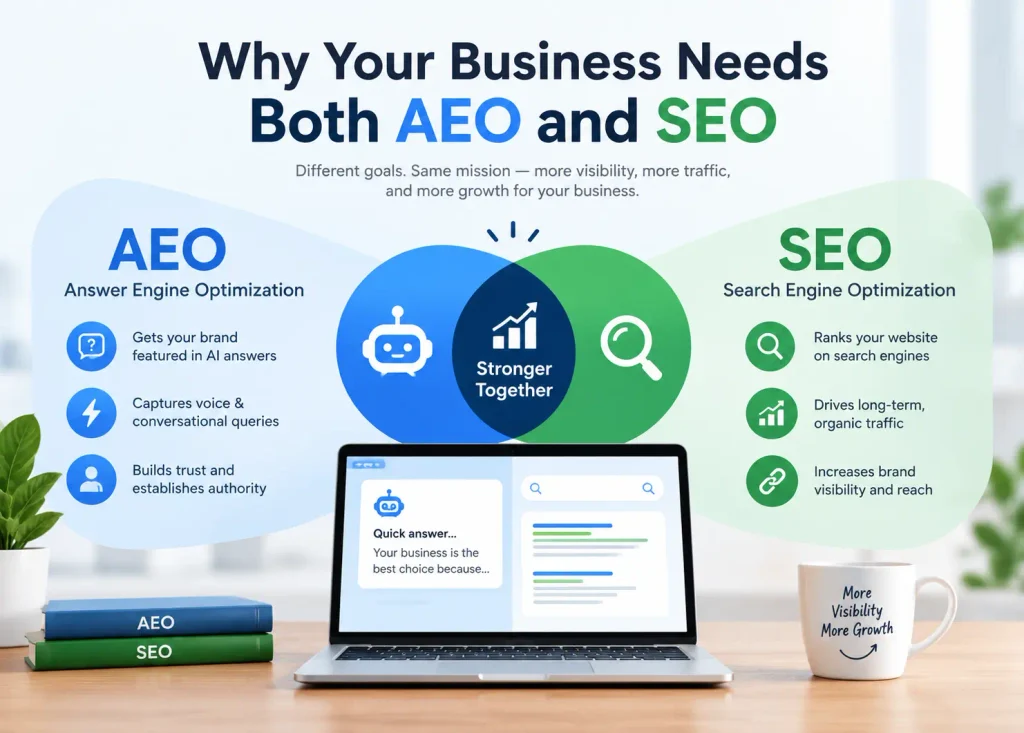
The evidence and changing search environment point toward a combined strategy.
SEO provides the foundation:
- Technical website health
- Keyword research
- Search intent
- Organic visibility
- Internal linking
- Content
- Authority
AEO adds another layer:
- Question-focused content
- Conversational language
- Clear answers
- Structured information
- Entity clarity
- AI-search visibility monitoring
- Brand and third-party presence
Think of it this way:
SEO helps your business compete in search results. AEO helps your business prepare for search experiences that provide answers instead of only lists of links.
You don’t need to abandon one to invest in the other.
How To Optimize Your Website for Both SEO and AEO
1. Research Keywords and Customer Questions
Don’t stop at keyword volume. Find out what customers actually want to know.
Look at:
- Search queries
- FAQs
- Sales-team questions
- Customer reviews
- Competitor content
- Related searches
- Industry questions
2. Give Direct Answers
Don’t make customers read 1,500 words to find a two-sentence answer.
Use clear headings, short explanations, bullet points, examples, and comparison tables.
3. Build Topic Depth
Create supporting content around your core services.
For example:
SEO Services → Local SEO → Technical SEO → SEO for Healthcare → SEO for B2B → SEO Pricing → SEO FAQs
This gives customers more useful information and creates a stronger internal linking structure.
4. Strengthen Technical SEO
Make sure important pages can be crawled, indexed, and understood.
5. Use Structured Data Correctly
Schema can help search engines understand eligible content, but it should be implemented accurately. It does not guarantee rankings, AI citations, or inclusion in a specific search feature.
6. Build Your Brand Beyond Your Website
Relevant third-party coverage, reviews, industry publications, business profiles, and consistent company information can all contribute to how your business is understood online.
7. Measure Both Search and AI Visibility
Monitor traditional metrics such as:
- Impressions
- Clicks
- Rankings
- Organic traffic
- Conversions
Then add emerging AI visibility signals such as:
- Brand mentions
- Citations
- AI referral traffic
- Share of voice
- Prompt visibility
Don’t judge your entire strategy from one AI response or one ranking position.
How VinzoTech Helps Businesses Build SEO and AEO Visibility
For a business owner, managing keywords, technical SEO, content, AI visibility, competitors, and conversions can quickly become complicated.
VinzoTech can bring these activities together through a combined search strategy focused on your business goals.
That can include:
- SEO strategy
- On-page SEO
- Technical SEO
- Content strategy
- Local SEO
- AEO strategy
- AI search visibility
- Keyword and question research
- Competitor analysis
The goal isn’t simply to create more content. It’s to make your business easier to discover, understand, and evaluate throughout the customer journey.
Want to know where your business currently stands in traditional and AI search? Talk to the VinzoTech team for a free visibility audit.
Frequently Asked Questions About AEO vs SEO
SEO focuses primarily on improving visibility in organic search results, while AEO focuses on making content clear and useful for answer-driven and AI-powered search experiences.
AEO can complement an existing SEO strategy. Many AEO practices use the same fundamentals as SEO, including helpful content, technical accessibility, search intent, and authority.
No. Businesses can use AEO alongside SEO. Traditional organic search remains important, while AI-powered search is creating additional ways for customers to discover information.
SEO tools like Google Search Console, Semrush, Ahrefs, and Screaming Frog help with rankings, keywords, technical issues, and backlinks. AEO tools like HubSpot AEO and Profound track how often your business is mentioned or cited in AI answers. Google Search Console now also shows how often your pages appear in AI Overviews and AI Mode. You don’t need to replace your SEO tools. Just add AEO tracking on top.
It can be particularly useful for B2B businesses because buyers often conduct extensive research before contacting a provider. Answer-focused content can help address questions throughout that research process.
Yes. A business can use SEO to build its organic search foundation while incorporating question-focused content, structured information, topical depth, and AI visibility monitoring into the same broader strategy.
Start with customer questions and search intent. Create direct, useful answers, organize content clearly, strengthen technical SEO, build topical authority, maintain accurate business information, and monitor how your brand appears across relevant search experiences.
Conclusion
AEO vs SEO isn’t an either-or decision for most businesses.
SEO remains an important foundation for organic visibility, while AEO addresses the growing importance of answer-driven and AI-powered search experiences.
The businesses that adapt aren’t necessarily the ones publishing the most content. They are the ones that make their expertise easy for customers -and search systems – to understand.
For business owners, the practical approach is to build a strong technical SEO foundation, create useful content around real customer questions, develop topical authority, strengthen your brand’s online presence, and monitor both traditional search performance and emerging AI visibility.
Search will continue to evolve. Your strategy should evolve with it.
Get Your Business Ready for SEO & AEO
See how your website performs across traditional search and AI-powered search. Get a practical SEO & AEO visibility audit to identify content, technical, and AI-search opportunities that can help your business get discovered by more potential customers.
Get Your SEO & AEO Audit