
To track competitor rankings in AI search results, you need to monitor more than where a brand appears in a traditional search result. Record which competitors are mentioned, recommended, cited, and linked for the same set of prompts across platforms such as Google AI Overviews, Google AI Mode, ChatGPT Search, and Perplexity. Then compare those results over time.
The measurement has become easier on Google’s side. As of August 31, 2026, Google has rolled out Search Console reports that show how a site’s pages appear in generative AI features, including impressions, pages, countries, devices, and performance over time. That data is useful for measuring your own visibility, but it does not provide a complete view of competitor mentions or citations, so a separate competitor-tracking process is still needed.
The important point is that AI search does not always behave like a traditional 10-result search page. A competitor can be mentioned in an answer, recommended as an option, or cited as a source without holding a fixed position. Your tracking system needs to record those differences.
What Counts as a Competitor Ranking in AI Search?
A traditional SEO report might tell you that a competitor ranks third for a particular keyword. AI search often gives you a different type of result.
A user might ask:
“What are the best SEO agencies for SaaS companies?”
The answer could mention four agencies, cite two websites, refer to a third-party publication, and provide different sources after another search.
So when tracking AI search competitors, think in terms of visibility, not just position.
Traditional rankings vs. AI search visibility
| Traditional SEO | AI search |
| Keyword position | Brand appearance |
| Ranking URL | Cited URL |
| Organic result | AI recommendation or mention |
| SERP visibility | Response visibility |
| Keyword tracking | Prompt tracking |
| Ranking changes | Mention and citation changes |
| Organic CTR | Clicks from cited sources |
Google explains that AI Overviews and AI Mode can use multiple searches to construct an answer and may show different supporting links. That makes a single position number less useful than a record of what appeared for a consistent query set.
The metrics worth tracking
A practical AI competitor report should include:
- Mention rate: How often a competitor appears in responses.
- Recommendation rate: How often the competitor is actually suggested to the user.
- Response order: Where the competitor appears when the answer lists several brands.
- Citation rate: How often the competitor’s website or another source about the competitor is cited.
- Cited URL: The exact page that appears as a source.
- Source domain: The publication, directory, review site, forum, or other website providing the citation.
- Prompt coverage: The percentage of tracked prompts where the competitor appears.
- Share of Voice: The competitor’s share of appearances within your defined dataset.
- Change over time: Whether visibility is increasing, decreasing, or staying relatively stable.
These measurements should be kept separate. A brand mention is not the same as a recommendation, and a recommendation is not necessarily the same as a citation.
Read Also: How to Get Your Company Mentioned by ChatGPT
Start With the Right Competitor Set
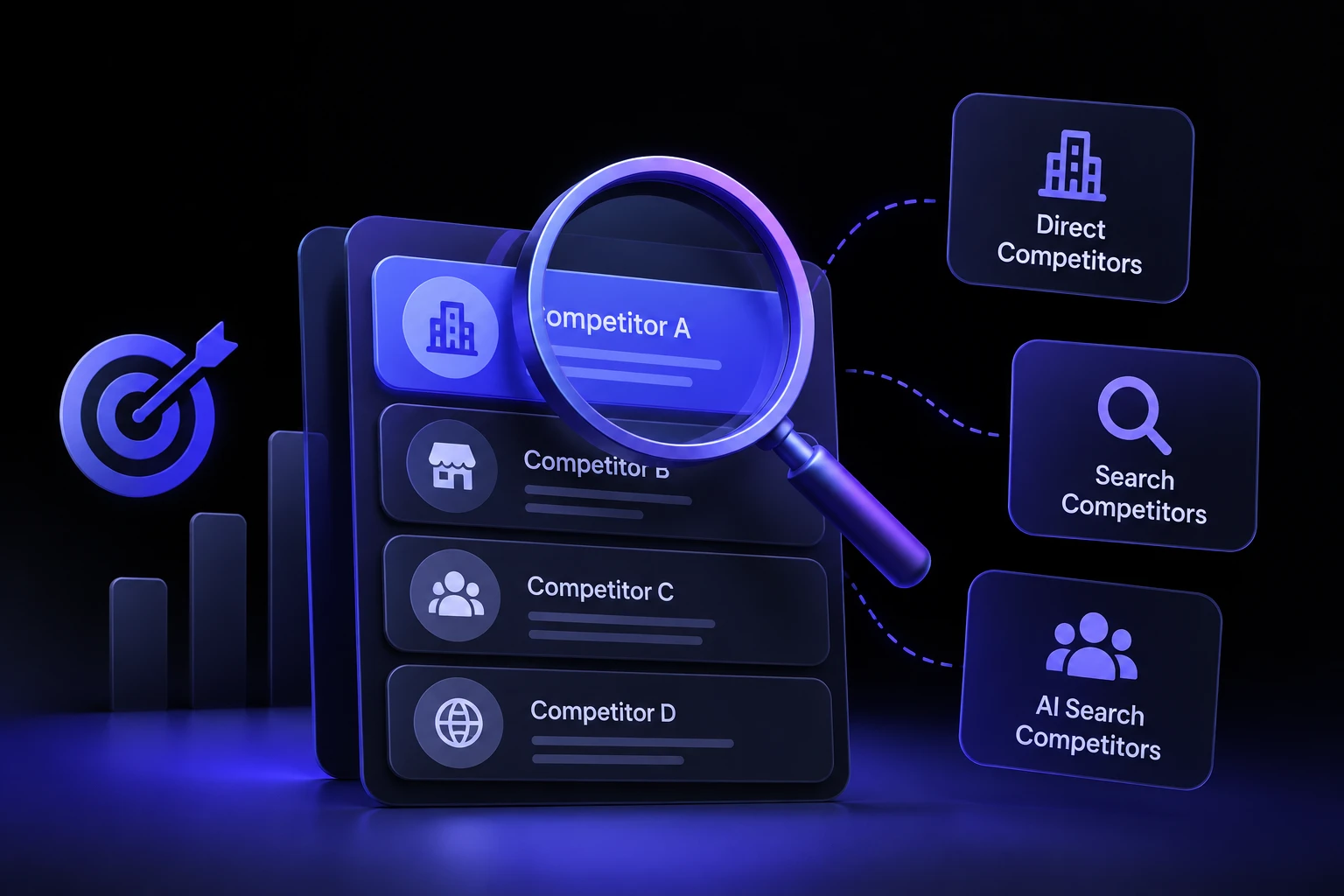
Your traditional SEO competitors are a useful starting point, but they should not be the entire list.
AI search can introduce competitors that you may not have considered direct competitors. A review website, industry publication, directory, consultant, marketplace, or comparison article can repeatedly appear in answers even though it does not sell the same product or service.
It helps to divide competitors into three groups.
Direct competitors sell similar products or services to the same audience.
Search competitors compete for the same organic search queries, even if their business model is different.
AI-search competitors are the brands and sources that repeatedly appear when users ask questions related to your products, services, industry, or buying decisions.
That third group is the one many companies miss.
Find AI competitors from real customer questions
Start with questions that reflect how people actually research a purchase or service.
For an SEO agency, that could include:
- What are the best SEO agencies for SaaS companies?
- Which SEO agencies specialize in local SEO?
- What should I look for when choosing an SEO agency?
- Which agencies provide Generative Engine Optimization?
- What are alternatives to [competitor]?
- Which SEO agencies work with manufacturing companies?
- What are the best digital marketing agencies in Melbourne?
- How can a business improve its visibility in AI search?
These prompts are more useful than simply entering your top target keywords into an AI platform.
A person looking for a service may never ask an AI system to “rank SEO agency Melbourne.” They may ask for recommendations, comparisons, pricing factors, or agencies with experience in a particular industry.
Your competitor list should reflect those questions.
Build a Fixed AI Search Prompt Set
If you want to measure changes over time, use a consistent group of prompts.
Testing 50 different questions in September and another 50 unrelated questions in October will not tell you whether your visibility changed. It only tells you that you asked different questions.
Create a core prompt set and keep it stable.
Group prompts by search intent
A useful set might include five types of prompts.
Informational
- What is Generative Engine Optimization?
- How does AI search determine which sources to cite?
Commercial investigation
- What are the best GEO agencies for businesses?
- Which agencies help companies improve AI search visibility?
Comparison
- SEO vs. GEO: What is the difference?
- What should a business look for when comparing SEO agencies?
Recommendation
- Which SEO agencies should a SaaS company consider?
- Which agencies specialize in enterprise SEO?
Problem-based
- How can a company increase its visibility in AI search?
- How can a brand get cited in AI-generated answers?
You can also add local and industry-specific prompts if location or specialization matters to your business.
Record the conditions for every test
For every prompt, record:
- Date
- Platform
- Prompt
- Country or location
- Language
- Competitors mentioned
- Your brand mentioned or not
- Response order
- Recommendation status
- Citation status
- Cited URL
- Source domain
- Notes
This turns random AI searches into a dataset that you can compare later.
Track Competitor Visibility Across AI Search Platforms
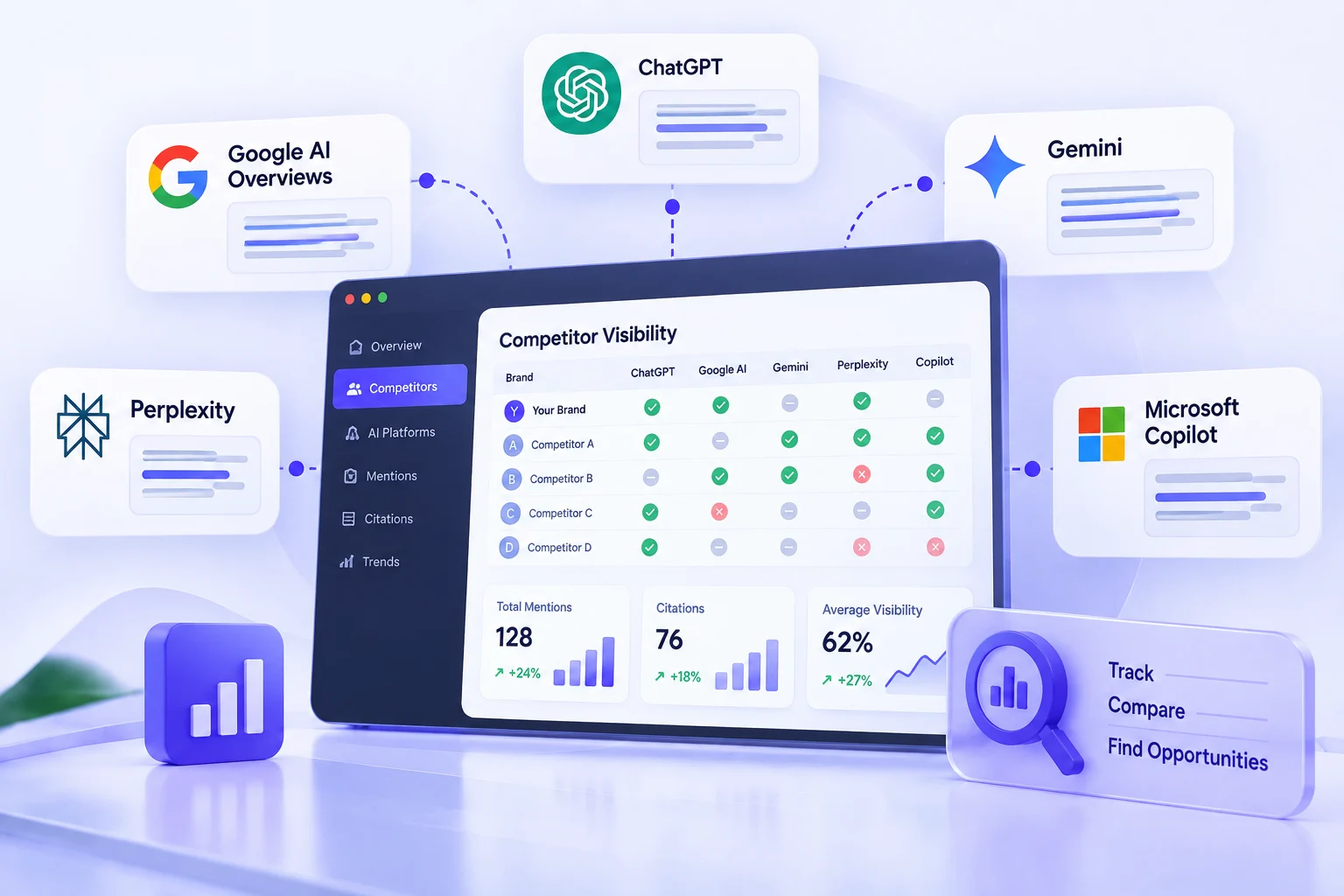
Do not assume that one AI platform represents the entire search environment.
The same prompt can produce different results across Google AI Mode, ChatGPT Search, Gemini, Perplexity, and other systems. Each platform has its own search and response process.
Google AI Overviews and AI Mode
Google’s AI search features can generate answers and provide links to supporting web pages. Google also explains that AI Mode can break a complex query into multiple related searches before constructing a response.
That matters for competitor tracking because the final answer may be influenced by several related searches rather than one conventional keyword.
Record:
- Whether your competitor appeared
- Whether your website appeared
- Which pages were cited
- Which third-party sources appeared
- The prompt used
- The date and location
Google’s new generative AI reporting in Search Console can help you understand your own pages’ visibility in AI Overviews and AI Mode. It is useful for your site’s performance, but competitor mentions still need to be tracked separately.
ChatGPT Search
ChatGPT Search provides answers with links to web sources. Those sources can include news articles, blog posts, and other web pages.
For competitor research, look at two separate things:
Was the competitor mentioned?
and
Was a source about the competitor cited?
Those results can be very different.
A company might be recommended in the answer while the supporting source is an independent publication. In another response, the company’s own service page might be cited.
Both are worth recording.
Perplexity and other AI search platforms
The same tracking principle applies to other AI search systems.
You do not need to know the internal ranking formula of each platform to conduct useful competitor research. You can work with what is observable:
- Which brands appear?
- Which brands are recommended?
- Which sources are cited?
- Which URLs are cited?
- Which domains appear repeatedly?
- Does the same competitor appear for several related prompts?
That information is enough to identify patterns.
Measure Competitor Mentions, Citations, and Share of Visibility
Suppose you track 100 prompts across your selected AI platforms.
Your report might show:
| Metric | Your Brand | Competitor A | Competitor B |
| Brand mentions | 31 | 42 | 27 |
| Recommendations | 18 | 29 | 15 |
| Website citations | 14 | 25 | 11 |
| Third-party citations | 9 | 17 | 13 |
These figures are an illustrative example, not actual search results.
The value comes from keeping the same methodology each month.
Track brand mentions
A mention tells you that the AI response included the brand.
That is useful, but it does not tell you whether the brand was presented positively, recommended, compared with another company, or simply referenced as an example.
Record the context.
For example:
“Brand A is a well-known provider of X.”
is different from:
“For a company looking for X, Brand A is one option to consider.”
The second statement has a clearer recommendation intent.
Track citations separately
Citations deserve their own field.
A competitor might receive many mentions but few direct website citations. Another competitor might appear less often but have a high percentage of cited responses.
You can record:
Citation rate = cited appearances ÷ total competitor appearances
This gives you another way to compare visibility within your dataset.
Calculate AI Search Share of Voice
A simple internal measurement is:
AI Search Share of Voice = Brand appearances ÷ total tracked brand appearances × 100
For example, if four brands account for 100 recorded appearances and one brand appears 35 times, that brand has a 35% share within that dataset.
Do not treat this as an official search-engine ranking score.
It only describes the sample you measured. The result depends on your prompts, platforms, location, language, date range, and counting method.
That limitation is important. A Share of Voice number is useful for comparing your own tracking periods, but it should not be presented as a universal measure of AI search authority.
Find Which Pages and Sources Are Helping Competitors Appear
This is where competitor tracking becomes much more useful.
Knowing that a competitor appeared 25 times tells you what happened. Finding the pages and sources behind those appearances helps explain why.
Analyze the competitor’s cited URLs
For each competitor citation, record the exact URL.
Then examine:
- What topic does the page cover?
- Is it a service page, guide, comparison page, case study, or research article?
- Does it answer a specific question?
- Does it contain original information?
- Does it cite credible sources?
- Does it demonstrate industry knowledge?
- Is the information current?
- Does it clearly explain the company or product?
- Does it link to supporting pages?
You may discover that a competitor’s AI visibility is connected to a very specific page rather than its homepage.
That distinction can change your content strategy.
Look beyond competitor websites
The source behind a competitor’s visibility may be somewhere else.
For example, an AI response could recommend a company and cite:
- An industry publication
- A review website
- A business directory
- A research report
- A comparison article
- A news story
- A forum discussion
- A partner website
This is why AI competitor analysis should include the wider web.
If a competitor is repeatedly associated with an authoritative publication, that publication becomes part of the visibility picture.
The goal is not to manufacture similar mentions. First understand what information the source provides and why it is useful to the query.
Identify repeated sources
Keep a separate list of domains that appear frequently in your tracked responses.
After several months, patterns may emerge.
You may find that:
- One publication frequently appears for industry questions.
- One review site is repeatedly cited for commercial comparisons.
- A particular competitor page appears for product-related questions.
- Certain research pages are repeatedly used to support factual claims.
Those patterns are more useful than a single AI response because they give you something to investigate.
Turn Competitor AI Search Data Into Content Gaps
Once you know which competitors and sources appear, compare the information available to users.
Suppose a user asks:
“How do I choose a GEO agency?”
A competitor repeatedly appears because its website clearly explains:
- GEO strategy
- AI citations
- AI visibility measurement
- Competitor monitoring
- Reporting
- Content optimization
If your site only has a short page describing GEO, the gap is not simply “we need more keywords.”
The gap may be that the competitor answers more of the questions a buyer is asking.
Compare the actual pages
Look at the pages that appear repeatedly and compare:
- Topic coverage
- Specificity
- Original research
- Examples
- Supporting evidence
- Definitions
- Page structure
- Internal links
- Author information
- References
- Clarity of the main answer
Do not copy the competitor’s page.
The useful question is:
What information does the user get there that is difficult to find on my site?
That gives you a much better content brief.
Use Google Search Console Alongside AI Search Tracking
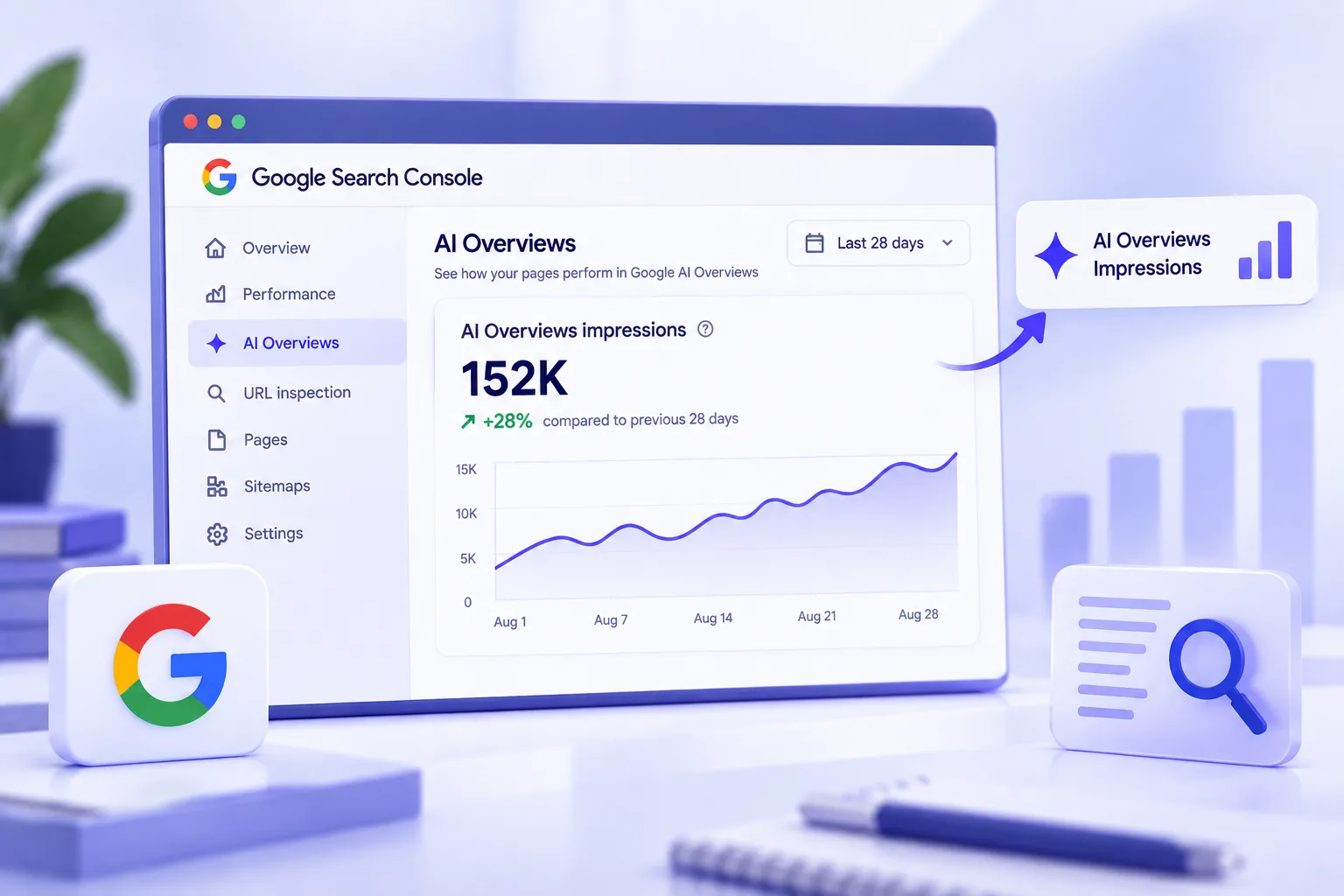
AI search tracking should sit alongside traditional SEO measurement.
Google’s Search Console now includes dedicated reporting for generative AI features in Search. The reports can show impressions, pages, countries, devices, and dates for visibility in Google’s generative AI experiences.
That gives site owners a direct source of data for their own Google AI visibility.
What Search Console can tell you
Depending on the available reporting, you can examine:
- Search impressions
- Clicks
- CTR
- Landing pages
- Countries
- Devices
- Generative AI visibility
- Changes over time
This is useful for measuring your own website.
What it does not replace
Search Console does not give you a complete competitor-monitoring dataset.
You still need to record:
- Competitor mentions
- Competitor recommendations
- Competitor citations
- Competitor URLs
- Third-party sources
- Prompt-level comparisons
- Cross-platform results
The two datasets answer different questions.
Search Console helps answer:
How is my site performing?
Competitor AI tracking helps answer:
Who is appearing alongside or instead of my brand, and what sources are associated with that visibility?
You need both if AI search is part of your search strategy.
Build a Simple Competitor AI Search Tracking Sheet
You do not need an expensive platform to start.
A spreadsheet can be enough for an initial tracking system.
Use columns such as:
| Field | What to record |
| Date | Date of the test |
| Prompt | Exact question asked |
| Platform | Google, ChatGPT, Perplexity, etc. |
| Location | Country or market |
| Your brand | Mentioned or not |
| Competitor | Brand appearing |
| Response order | Position/order in response |
| Mention type | Mention or recommendation |
| Citation | Yes or no |
| Cited URL | Exact source page |
| Source domain | Domain providing the source |
| Context | Why the brand appeared |
| Notes | Important observations |
Keep screenshots or exported records for important tests where possible. AI responses can change, so having the original result gives you something to review when a pattern looks unusual.
Add a monthly comparison
At the end of each month, compare the same core prompts.
Look for:
- New competitors
- Competitors that disappeared
- New citations
- Lost citations
- Frequently repeated sources
- Changes in response order
- New pages appearing
- Changes in your own visibility
Do not treat every month-to-month change as meaningful. A single different answer can be normal. Repeated changes across the same prompt group are more useful signals.
Common Mistakes When Tracking AI Search Competitors
Treating one AI answer as a ranking
An individual response is a data point, not a permanent ranking.
Run the same prompt again when a result seems important, then look for the same pattern across related prompts.
Tracking different prompts every month
This makes comparisons unreliable.
Keep a core prompt set and add experimental prompts separately.
Counting every mention equally
A passing mention, a recommendation, and a direct citation do not represent the same type of visibility.
Record them separately.
Looking only at direct competitors
A publication or review website may appear more often than a direct competitor for certain informational searches.
Include those sources in your analysis.
Ignoring the cited URL
Knowing that Competitor A appeared is useful.
Knowing that a particular comparison page on Competitor A’s website was cited repeatedly is much more actionable.
Ignoring location
AI search results can vary by market and language. If you operate in multiple countries, keep those markets separate in your reporting.
Treating third-party scores as official rankings
SEO and AI visibility tools can make competitor research easier, but their proprietary scores should not be confused with an official ranking from Google or another AI platform.
Use the tool as a measurement system and understand how its score is calculated before comparing it with other tools.
Trying to manufacture mentions
A competitor appearing in an AI answer does not mean you should create dozens of low-value pages or artificial mentions simply to generate similar signals.
Start with useful information, accurate pages, and credible sources.
How Often Should You Track Competitor AI Search Visibility?
A monthly full review is a practical starting point for most businesses.
For high-value commercial prompts, weekly checks can be useful. A larger monthly dataset gives you a better view of broader changes. A quarterly review can then look more closely at cited sources, competitor pages, and content gaps.
A simple schedule is:
Weekly: Check priority commercial prompts.
Monthly: Run the full fixed prompt set.
Quarterly: Analyze competitor pages, citations, third-party sources, and content gaps in more detail.
After major content changes: Re-test the prompts connected to the updated pages.
The right frequency depends on how much AI search contributes to your customer research and how many prompts you need to track.
What to Do When a Competitor Starts Appearing More Often
Do not immediately rewrite your entire website.
First, confirm the pattern.
Run the same prompt under the same conditions and check related prompts. Then look at what changed.
Step 1: Confirm the pattern
Record several results instead of relying on one response.
Step 2: Find the sources
Identify the competitor pages and third-party sources that appear.
Step 3: Compare the information
Look at what those pages answer well and what your site does not cover.
Step 4: Fix the actual gap
That could mean improving an existing page, creating a genuinely useful supporting article, adding original research, clarifying a service, or improving internal links.
Step 5: Re-test
Use the same prompts after the changes.
The point of the process is to connect a visibility change with an actual content or search change, rather than guessing from one AI response.
The Role of SEO, AEO, and GEO in Competitor AI Search Tracking
AI search tracking works best as another layer of search measurement.
Traditional SEO still matters because search engines need to discover, crawl, understand, and index your content. Google’s guidance for AI features states that the same basic technical requirements and SEO fundamentals continue to apply to pages appearing in AI search features.
AEO and GEO add another measurement layer.
SEO focuses heavily on visibility in conventional search results.
AEO focuses on providing clear answers to questions and answer-oriented searches.
GEO focuses on visibility within generative search experiences where systems generate responses, recommendations, and summaries.
The practical approach is to connect these areas instead of treating them as separate marketing projects.
Track:
Traditional rankings + AI mentions + citations + cited sources + organic performance
That gives you a clearer view of how your website is being discovered across different search experiences.
Track AI Search Competitors With VinzoTech
Competitor tracking becomes much more useful when it connects directly to a broader search strategy.
VinzoTech’s Generative Engine Optimization services focus on AI search visibility across platforms such as ChatGPT, Gemini, and Perplexity, with work around content, entities, topical authority, and signals that can support AI references and recommendations.
The broader SEO services also cover technical SEO, on-page optimization, content strategy, local SEO, AEO, and GEO.
For a business trying to understand why competitors appear in AI-generated answers, the process starts with the same questions covered in this guide: which prompts produce visibility, which competitors appear, what pages and sources are cited, and where useful content gaps exist.
A competitor AI-search audit can then turn those findings into a practical list of pages, topics, technical improvements, and authority opportunities to work on.
FAQs
Track a fixed set of relevant prompts across AI search platforms such as Google AI Overviews, Google AI Mode, ChatGPT Search, Gemini, and Perplexity. Record which competitors are mentioned, recommended, cited, and linked, then compare the results over time.
Useful metrics include brand mentions, recommendation frequency, response position, citation frequency, cited URLs, source domains, prompt coverage, Share of Voice, and changes in visibility over time.
No. Traditional Google rankings usually refer to a page’s position for a specific keyword. AI search can generate an answer containing several brands and sources, so competitor visibility is better measured through mentions, recommendations, citations, and supporting links.
Create a consistent list of customer-focused prompts and run them through ChatGPT Search. Record which competitors appear, how they are described, whether their websites are cited, and which third-party sources are referenced.
Use a fixed set of queries and record the brands, pages, and supporting sources shown in the AI results. Keep the location, language, date, and query consistent where possible so you can compare results over time.
AI Search Share of Voice is a measurement of how frequently a brand appears compared with other tracked brands within a defined set of AI-search prompts. A simple calculation is brand appearances divided by total tracked brand appearances, multiplied by 100.
A brand can be mentioned without its website being cited, while another brand may receive fewer mentions but have its website cited more often. Tracking both helps show the difference between general visibility and source-level visibility.
A monthly full review is a practical starting point. High-value commercial prompts can be checked weekly, while a deeper review of competitor pages, citations, and content gaps can be performed quarterly.
Track direct business competitors, traditional search competitors, and AI-search competitors. The last group can include publishers, review websites, directories, comparison sites, and other sources that repeatedly appear in AI-generated answers for relevant prompts.
Competitor tracking can show which topics, pages, citations, and third-party sources are associated with competitor visibility. You can use those findings to identify content gaps, improve relevant pages, strengthen internal linking, and refine your SEO, AEO, and GEO strategy.
Track Your Competitors Across AI Search
Discover which competitors are being mentioned, recommended, and cited in AI search results. Get clear insights into the prompts, pages, and sources behind their visibility.
Improve Your AI Search Visibility With Us