
To improve visibility in Google AI Overviews, focus on the same SEO foundations that make a page eligible for Google Search, then make the content genuinely useful, specific, easy to understand, and supported by reliable information. There is no separate AI Overview schema or technical trick that guarantees inclusion. Google says pages must be indexed and eligible to appear in normal Search, while helpful, reliable, people-first content remains the foundation for its AI search features.
The opportunity is already significant. Pew Research Center found that 58% of the U.S. adults in its March 2025 browsing-data sample encountered at least one Google search that produced an AI-generated summary. Longer, question-based searches were especially likely to produce one.
That changes how SEO teams should think about search visibility. Ranking a page in the traditional results still matters, but the page also needs to provide information that can support a user’s broader search journey.
What Google AI Overviews Mean for SEO
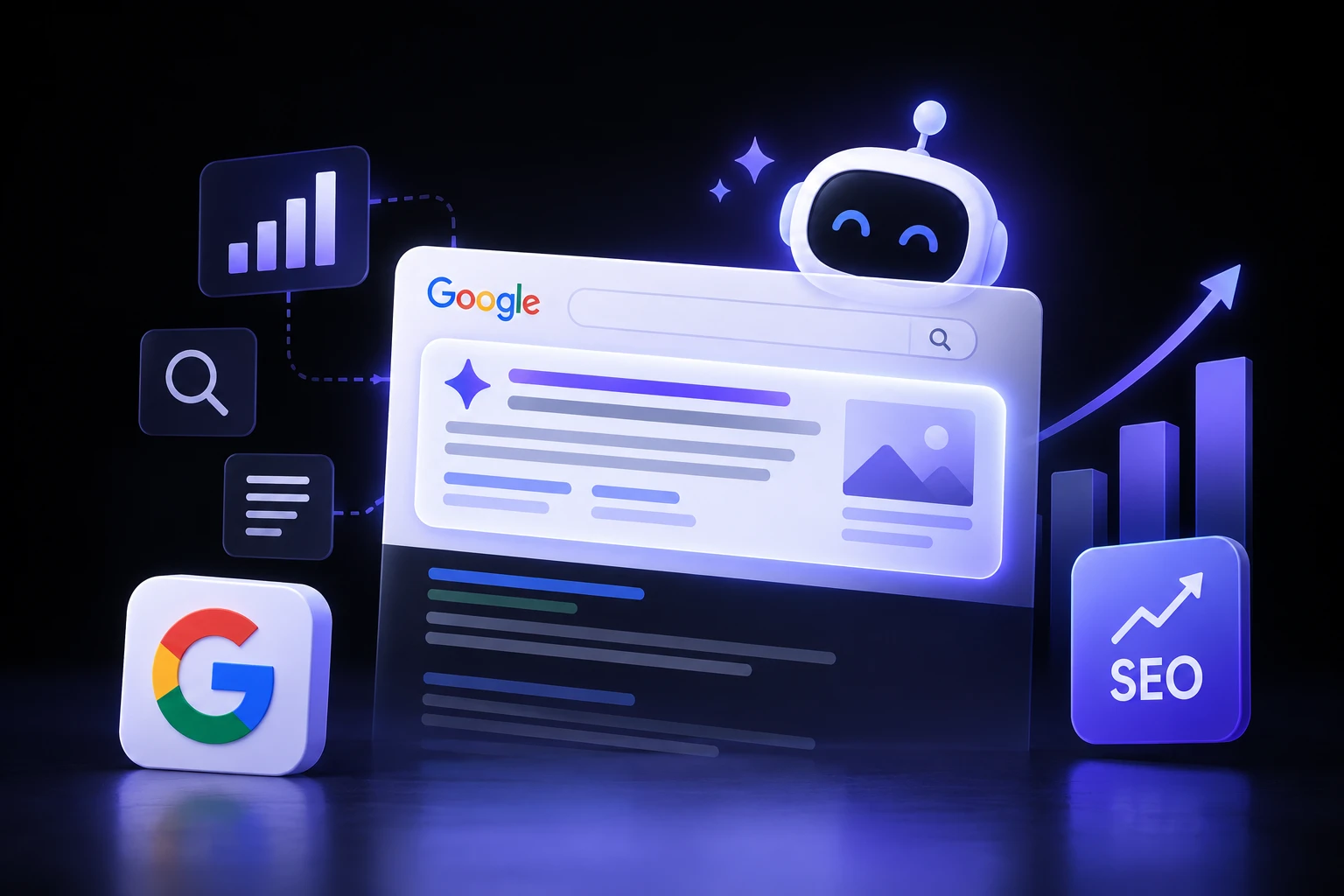
Google AI Overviews provide an AI-generated response for some searches and include links to supporting webpages. They are designed to help users understand a topic or question quickly and then explore the sources behind the answer.
This does not mean traditional SEO has become irrelevant.
Google’s current documentation says its AI search features are built on its existing Search systems. AI Overviews and AI Mode can retrieve information from Google’s Search index, evaluate relevant pages and show supporting links. Google also says the results and links can vary because these systems may use multiple related searches to build a response.
That creates an important distinction.
A page can compete in traditional organic results while also becoming a supporting source for an AI-generated response. The two experiences are connected, but they are not identical.
For SEO teams, this means a page should do more than target a keyword. It should answer the underlying question clearly and provide enough useful context for the topic.
Can You Actually Rank in Google AI Overviews?
There is no traditional “position one” ranking system for AI Overviews that you can optimize for in the same way as a standard organic result.
Google describes websites appearing in AI Overviews and AI Mode as supporting links. To be eligible, a page needs to be indexed and eligible to appear in Google Search with a snippet. Google says there are no additional technical requirements specifically for AI Overviews.
So when someone asks how to rank in Google AI Overviews, the more accurate answer is:
Build a page that is eligible for Google Search, satisfies the search intent, provides useful information, and gives Google a strong source to use when answering related queries.
That starts with the basics.
Make sure Google can crawl and index the page
Check that:
- Googlebot is allowed to crawl the page.
- The page is not accidentally blocked by robots.txt.
- Important content is accessible to search engines.
- Internal links make the page easy to discover.
- Canonical signals are appropriate.
- The page is eligible for indexing.
- The content is available in a form Google can process.
A technically excellent article cannot appear in an AI Overview if Google cannot properly access or index it.
Don’t look for an AI Overview schema
There is no special schema markup that makes a page eligible for AI Overviews.
Structured data still has a role in normal SEO and eligible Search features, but Google does not require a special “AI Overview schema.”
The same applies to AI-specific files. Creating an llms.txt file does not give a page a special advantage in Google Search. Google’s current guidance says there is no need to create new machine-readable files or AI-specific markup for these search features.
That is useful to know because a lot of AI SEO advice focuses on technical additions that Google itself does not require.
Create Content That Gives Google Something Useful to Cite
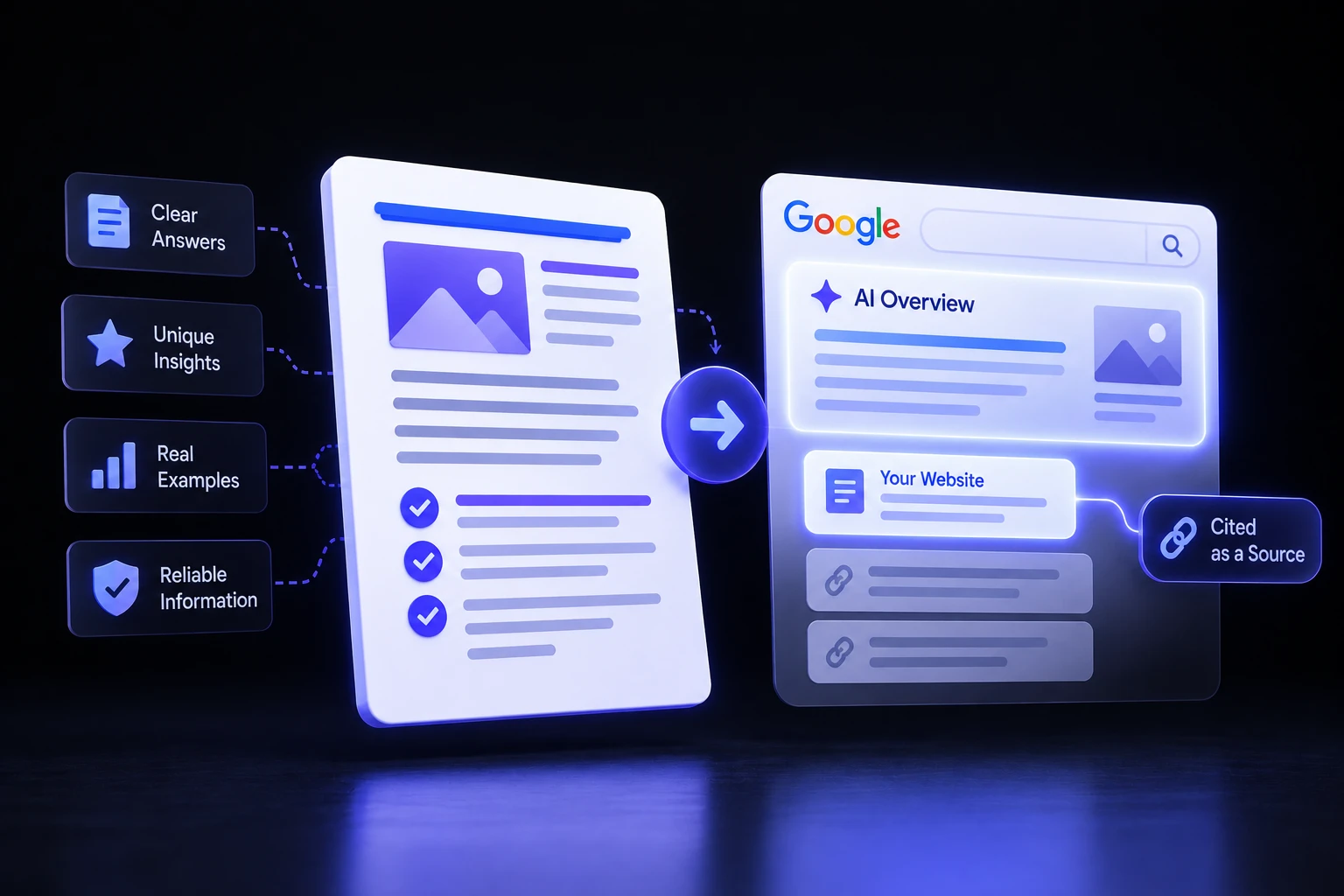
A page is more useful when it adds information instead of repeating the first page of search results.
Consider two articles targeting the same question.
The first gives a short definition, repeats a few commonly known points and ends with generic advice.
The second explains the answer, shows how to apply it, discusses limitations, compares different approaches and supports important claims with sources.
The second page gives both the reader and the search system more useful information to work with.
Google’s guidance for generative AI search specifically encourages unique, non-commodity content that provides value beyond what is already available elsewhere.
Answer the main question early
If someone searches for “how to improve visibility in Google AI Overviews,” they should not have to read an introduction about the history of artificial intelligence before getting an answer.
Start with the answer.
Then explain the reasoning, evidence and implementation details.
A useful structure for many informational pages is:
Question → direct answer → explanation → evidence → example → related considerations
This is not a Google-approved formula for getting cited. It is simply a clear way to organize information around the user’s actual need.
Add information that competitors are missing
Look beyond keyword gaps.
Ask:
- What does the current search result fail to explain?
- Are important limitations missing?
- Are there examples?
- Are claims supported?
- Is there first-hand experience that can be added?
- Does the page explain what to do, or only what something is?
- Are there useful comparisons?
- Does the article answer obvious follow-up questions?
These questions often produce better content improvements than adding another 500 words.
Use specific language
Avoid sentences such as:
AI is changing the way businesses approach SEO.
That sentence does not tell the reader much.
A more useful explanation would identify the actual change:
Search results can now provide an AI-generated response before the traditional organic listings, which can change how often users click through to individual webpages.
The second sentence gives the reader something concrete.
How to Structure Content for Google AI Overviews
Good structure makes information easier for people to scan and understand. It also gives search systems clearer relationships between questions, answers and supporting information.
There is no required page length or requirement to break content into tiny sections for AI systems. Google specifically says its systems can understand related topics on a page and that there is no ideal word count for generative AI search.
Put the direct answer near the top
The most important answer should not be buried.
If a page explains how to calculate a particular metric, provide the formula and basic explanation before several paragraphs of background.
If the page compares two products, state the main difference early.
If the page explains a process, give the process before discussing its history.
This helps the reader first. Search visibility is a secondary benefit.
Use headings that describe the actual topic
A heading such as “Important Things to Know” does not tell anyone what follows.
A heading such as “How to Measure AI Overview Visibility in Search Console” does.
Descriptive headings also help organize related information without forcing exact-match keywords into every section.
Keep related information together
Suppose you are writing about local SEO.
Information about Google Business Profile, local landing pages, reviews and local citations should have a logical relationship. Don’t scatter these subjects across unrelated parts of the article simply to create more headings.
A clear information hierarchy makes the page easier to use.
Use short answers where short answers are enough
Some questions need two sentences.
Others need 500 words.
Do not make every answer the same length.
A definition can be concise. A technical process may need examples and caveats. A comparison may work better as a table.
The structure should follow the information, not an arbitrary word count.
Strengthen the Traditional SEO Foundations
Google’s guidance is clear on this point: the fundamentals of SEO remain relevant to AI Overviews and AI Mode.
That includes technical accessibility, internal linking, useful content, page experience and making important information available in text.
A strong content strategy cannot compensate for a page that Google cannot properly crawl or index.
Internal links are especially useful because they connect related pages and help search engines discover important content.
For example, a website publishing an article about AI search visibility may also have a broader SEO strategy page. A contextual link between the two makes sense when the reader wants to understand how AI search fits into a wider SEO program.
The same principle applies to structured data. Use it where it supports an eligible Search feature and make sure the markup accurately represents the visible content. Don’t add schema simply because an SEO checklist says every page needs more markup.
Build Topic Depth Instead of Creating Pages for Every Query
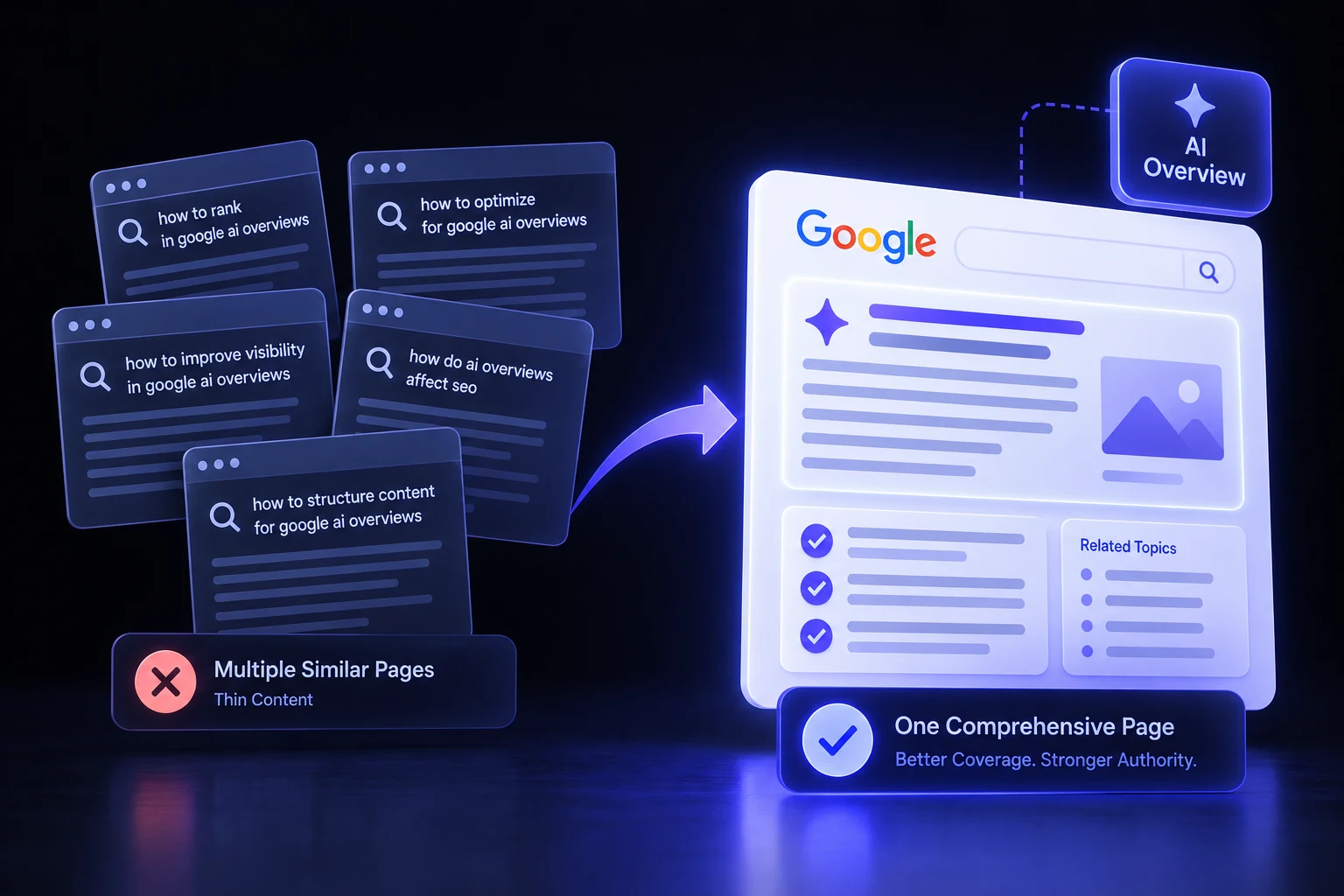
A common mistake is treating every keyword variation as a separate content opportunity.
Consider these searches:
- How to improve visibility in Google AI Overviews
- How to rank in Google AI Overviews
- How to optimize for Google AI Overviews
- How to get cited in Google AI Overviews
They are different phrases, but the search intent overlaps heavily.
Creating four nearly identical articles would probably make the site harder to manage and give readers four weaker resources instead of one strong one.
A single article can cover related questions when they belong to the same search intent.
Separate pages make more sense when the intent changes.
For example, an article explaining how AI Overviews work for website owners has a different purpose from a technical guide explaining how to diagnose indexing problems. Those topics can link to each other without needing to become one page.
The goal is not to publish a page for every keyword variation. The goal is to build useful coverage around a subject.
Use Internal Links to Connect Related Expertise
Internal linking becomes more useful when it reflects the site’s actual information architecture.
A page about Google AI Overviews can naturally connect to:
- broader SEO strategy
- technical SEO
- content strategy
- local SEO
- AI search optimization
- related research or guides
The anchor text should tell the reader what they will find after clicking.
Good:
A strong SEO strategy still provides the foundation for visibility across Google’s different search experiences.
Less useful:
Click here to learn more.
The link should make sense even if the reader ignores the fact that it is an internal link.
Make Your Content Easier to Trust and Verify
AI-generated search results can combine information from several sources. That makes source quality important.
For pages dealing with technical, financial, medical, legal or other sensitive subjects, claims should be supported by appropriate primary or authoritative sources.
For SEO content, Google’s own documentation is usually the best source for claims about how Google Search works.
That does not mean every sentence needs a citation.
Use sources where they add evidence.
For example, if you state that Google does not require special AI Overview markup, link to Google’s documentation. If you quote a research figure about user behaviour, link to the original research.
The rest of the article can explain the practical implications in your own words.
Measure Your Visibility in Google’s AI Search
Improving visibility is only half the process. You also need to know whether the changes are producing results.
Google now provides a Generative AI performance report in Search Console for measuring how content performs in generative AI features on Google Search.
This is more useful than relying entirely on third-party tools that claim to know an internal AI Overview ranking score. Third-party platforms can provide useful monitoring and analysis, but they do not have access to Google’s internal ranking systems.
The Google Search Console generative AI performance report can help identify how your content is being discovered through generative AI features.
What should you monitor?
Look at more than a single visibility number.
Track:
- Which pages receive generative AI visibility
- Which queries are associated with that visibility
- Organic impressions and clicks
- Changes in click-through behaviour
- Engagement after users reach the site
- Leads or other conversions
- Topics gaining or losing visibility
A page that receives fewer traditional clicks but reaches users through a more specific search journey may need a different interpretation from a page simply losing organic visibility.
Search Console data should be considered alongside analytics and conversion data.
Read Also: How to Track Competitor Rankings in AI Search Results
Avoid Tactics That Sound Like AI Overview Hacks
The growth of AI search has created a market for tools and techniques that promise special access to AI rankings.
Be careful with those claims.
Don’t stuff question keywords into every heading
Writing:
How to rank in Google AI Overviews
ten times across an article does not make the content more relevant.
Use natural variations when they help the reader.
Don’t create dozens of nearly identical pages
Changing a few words in the title and publishing another article on the same question does not create meaningful topic coverage.
If the reader would struggle to explain the difference between two pages, they may not need to be separate pages.
Don’t write tiny answer blocks with no useful context
A direct answer is good.
An answer with no explanation, evidence or practical detail is often not enough.
A useful page should give the reader the information needed to understand and act on the answer.
Don’t treat structured data as an AI shortcut
Structured data can help Google understand eligible content and support certain Search features.
It is not an AI Overview switch.
Don’t chase artificial mentions
Getting your brand mentioned on unrelated websites simply because you hope an AI system will notice it is a poor substitute for genuine authority.
Google’s current guidance also warns against seeking inauthentic mentions for generative AI visibility.
What AI Overviews Mean for Organic Traffic
AI Overviews can change how users interact with a search results page.
Pew Research Center’s analysis of 68,879 Google searches in March 2025 found that users who encountered an AI-generated summary clicked a traditional search result in 8% of visits, compared with 15% of visits without an AI summary. Links inside the AI summary itself were clicked in 1% of visits.
Those figures are useful context, but they should not be treated as a universal traffic forecast. The study covered U.S. browsing behaviour during a specific period, and AI search behaviour continues to change.
The practical lesson is more straightforward: impressions and rankings alone do not tell the entire story anymore.
A searcher may interact with an AI-generated answer before deciding whether to visit a website. If they do visit, the page needs to give them a reason to stay.
That makes content quality and conversion paths important alongside visibility.
A Practical Workflow for Improving AI Overview Visibility
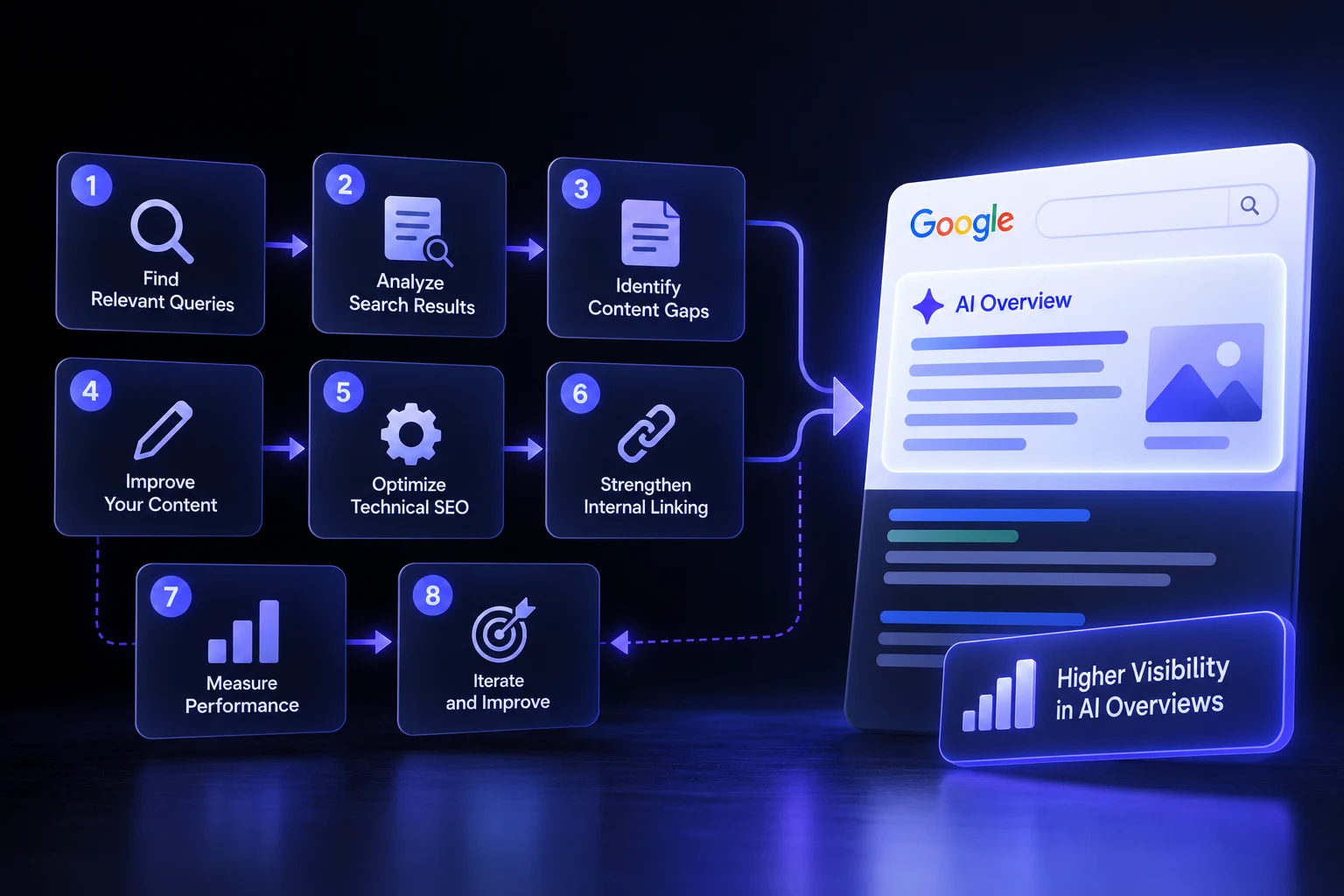
If you are working on an existing website, use a process like this rather than trying random AI SEO tactics.
1. Find the questions that matter
Start with queries that are relevant to the site’s products, services and audience.
Look for questions with clear informational or commercial intent.
Question-based searches deserve attention because they can trigger AI-generated summaries more often than very short searches. Pew’s research found that 60% of searches beginning with question words produced an AI summary in its study.
2. Review the current search results
Search the important queries manually.
Look at:
- Traditional organic results
- AI Overview sources
- Featured snippets where present
- Related searches
- Types of pages appearing
- Information that competitors provide
The goal is to understand what Google appears to consider useful for the query.
3. Compare your page with the actual search intent
Ask whether your page:
- Answers the main question
- Covers important subtopics
- Provides evidence
- Explains limitations
- Uses clear headings
- Gives the reader practical information
- Adds something beyond generic summaries
4. Improve the page itself
Fix the missing information.
Remove unnecessary filler.
Add examples where they clarify the subject.
Update outdated claims.
Improve the opening if the answer is buried.
Don’t rewrite the page simply to insert more keywords.
5. Check technical accessibility
Review indexing, crawlability, internal links, rendering and other technical SEO factors.
If Google cannot reliably access the content, improvements to the writing won’t solve the underlying problem.
6. Strengthen the site’s related content
Connect the page with other relevant articles and service pages.
This creates a clearer relationship between individual pieces of content and the wider subject.
7. Measure the results
Use Search Console, analytics and conversion data to understand what changed.
AI search visibility should be treated as part of the wider search strategy, not as a separate vanity metric.
How VinzoTech Can Help With AI Search Visibility
Improving visibility in Google AI Overviews starts with solid SEO: understanding search intent, making pages accessible to Google, building useful content, connecting related pages and measuring what happens after publication.
VinzoTech works across SEO, content optimization, Answer Engine Optimization, and Generative Engine Optimization. Its Generative Engine Optimization services focus on improving how businesses are understood and referenced across AI-powered search experiences, including Google, ChatGPT, Gemini and Perplexity.
The right approach is not to chase a shortcut for appearing in an AI Overview. It is to build a site that gives search systems clear, useful, and trustworthy information to work with, while giving the person who visits the page a good reason to continue.
FAQs
Focus on strong SEO fundamentals, useful and original content, clear answers to search queries, good internal linking, and technical accessibility. Your pages should be indexed and eligible to appear in Google’s normal search results.
There is no separate ranking position or guaranteed method for appearing in an AI Overview. Google selects supporting sources based on the query and the information it retrieves, so the focus should be on creating relevant, trustworthy content that clearly satisfies the search intent.
Yes. Google says the same core SEO practices used for Search also apply to its AI search features. Crawlability, indexability, internal links, helpful content, and clear page structure remain important.
No. Google does not require a special schema type for AI Overviews. Structured data can still support eligible Google Search features, but adding markup specifically to try to trigger an AI Overview is not a requirement.
Start with a direct answer to the main question, then provide supporting explanations, examples, evidence, and relevant details. Use descriptive headings and keep related information together so both readers and search systems can understand the page easily.
There is no ideal word count for appearing in AI Overviews. A page should be as long as necessary to answer the topic properly. Adding unnecessary paragraphs simply to make an article longer does not improve its usefulness.
Not when the keywords have the same search intent. Closely related queries can often be addressed with one strong page. Create separate pages when the search intent, audience, or information required is substantially different.
There is no Google requirement to create an llms.txt file for AI Overviews. Google’s current guidance recommends focusing on making your website accessible to Google Search and publishing useful, original content instead of relying on AI-specific files.
Use Google Search Console’s generative AI performance reporting alongside your normal SEO and analytics data. Look at the pages and queries receiving AI search visibility, then compare impressions, clicks, engagement, and conversions to understand the business impact.
They can change how users interact with search results, and research has found lower rates of traditional result clicks when an AI summary appears. The effect varies by query and website, so monitor your own Search Console, analytics, and conversion data instead of assuming a fixed traffic loss.
Get Your Website Ready for AI Search
Improve your visibility across Google AI Overviews and other AI search platforms with a clear SEO strategy built around search intent, useful content, technical SEO, and stronger content visibility.
Book A Free Call Now