

Most manufacturing websites get traffic. Very few get RFQs.
The reason is simple. A buyer landing on your product page is evaluating whether your company can actually do what they need. If they cannot find your tolerances, certifications, materials, or a clear way to request a quote, they move on. Your competitor gets the inquiry, not you.
To turn website traffic into qualified RFQs, manufacturers need pages built around how buyers evaluate suppliers, not how marketers build websites. That means buyer-intent SEO, clear capability pages, structured contact paths, and content that removes doubt before the first conversation.
This guide covers exactly how to make that happen.
Why Most Manufacturing Websites Get Traffic but Not RFQs
It is a familiar situation. Your analytics dashboard looks healthy. Organic sessions are up. Rankings are improving. But the sales team keeps saying the same thing in every pipeline meeting: qualified RFQs are still too low.
The problem is usually not traffic volume. It is traffic type.
Many manufacturing websites rank for educational terms. Searches like “what is CNC milling” or “types of injection molding processes” bring in traffic from students, researchers, and early-stage learners. That is not your buyer.
Your buyer is an engineer comparing two suppliers on lead time and tolerance capability. They are a procurement manager shortlisting vendors for a new production run. They are a sourcing team verifying certifications before sending a quote request.
These visitors search very differently. They use specific, procurement-intent queries. And if your pages are not built for that level of intent, they leave without converting.
According to a Thomas Industrial Buyers survey, 73% of B2B buyers say they pay close attention to a supplier’s website when deciding whether to submit an RFI. That is not a minor influence. That is a direct pipeline variable.
The Difference Between Traffic and Buyer Intent in Manufacturing
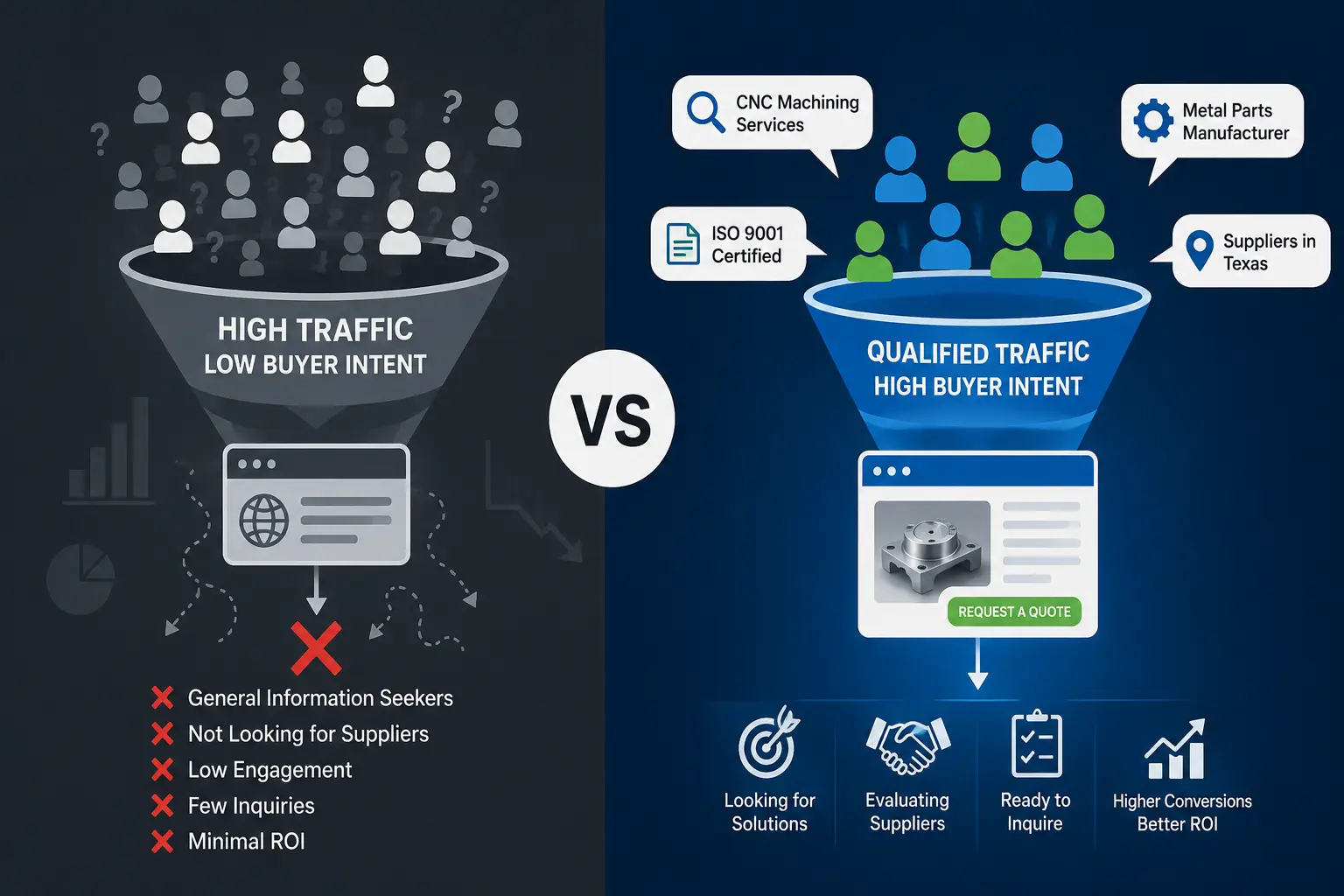
Not all search traffic is equal. In manufacturing, the gap between informational traffic and procurement-ready traffic is enormous.
Consider these two searches:
- “stainless steel fabrication process”
- “stainless steel fabrication supplier aerospace California”
The first brings in traffic. The second brings in buyers.
Long-tail, specification-driven queries are where your real pipeline lives. The search volume is smaller, but the commercial value per visit is significantly higher. A single qualified RFQ in manufacturing can represent five or six figures in contract value. That changes how you should think about SEO.
Buyers in industrial procurement search by:
- Material and grade
- Process capability (CNC, laser cutting, stamping, casting)
- Tolerances and surface finish requirements
- Certifications (ISO 9001, AS9100, IATF 16949)
- Industry served (aerospace, medical, automotive, defense)
- Location or shipping region
If your pages are not built around these parameters, you are invisible at the moment your buyer is making their decision.
Our manufacturing SEO services are built specifically around this buyer search behavior, not generic traffic metrics.
What Manufacturing Buyers Actually Look at Before Submitting an RFQ
When a procurement manager lands on your website, they are not browsing. They are checking boxes.
Here is what they are typically looking for before they will submit a quote request:
Capabilities and tolerances. Buyers want to see exactly what your facility can produce. Vague language like “precision machining” tells them nothing. Specific information like “CNC turning with tolerances to ±0.001 inches” tells them everything.
Certifications. ISO, AS9100, IATF, UL, and similar certifications are trust signals. They should not be buried in a footer. They belong on capability pages, product pages, and the homepage.
Industry experience. Have you worked in aerospace before? Medical devices? Defense? Buyers in regulated industries need to know their supplier has been there before. Case studies, client industries listed, and example applications all help here.
Lead time and minimum order information. Buyers sourcing for production want to know early whether you fit their timeline and volume. Hiding this information creates friction.
Downloadable spec sheets and capability guides. Technical PDFs position your company as a serious supplier and support the buyer’s internal approval process.
A clear RFQ path. A generic “contact us” form does not work for manufacturing buyers. They need a form specifically set up for quote requests, with fields for part description, material, quantity, and timeline.
How to Optimize Your Manufacturing Website Pages to Generate RFQs
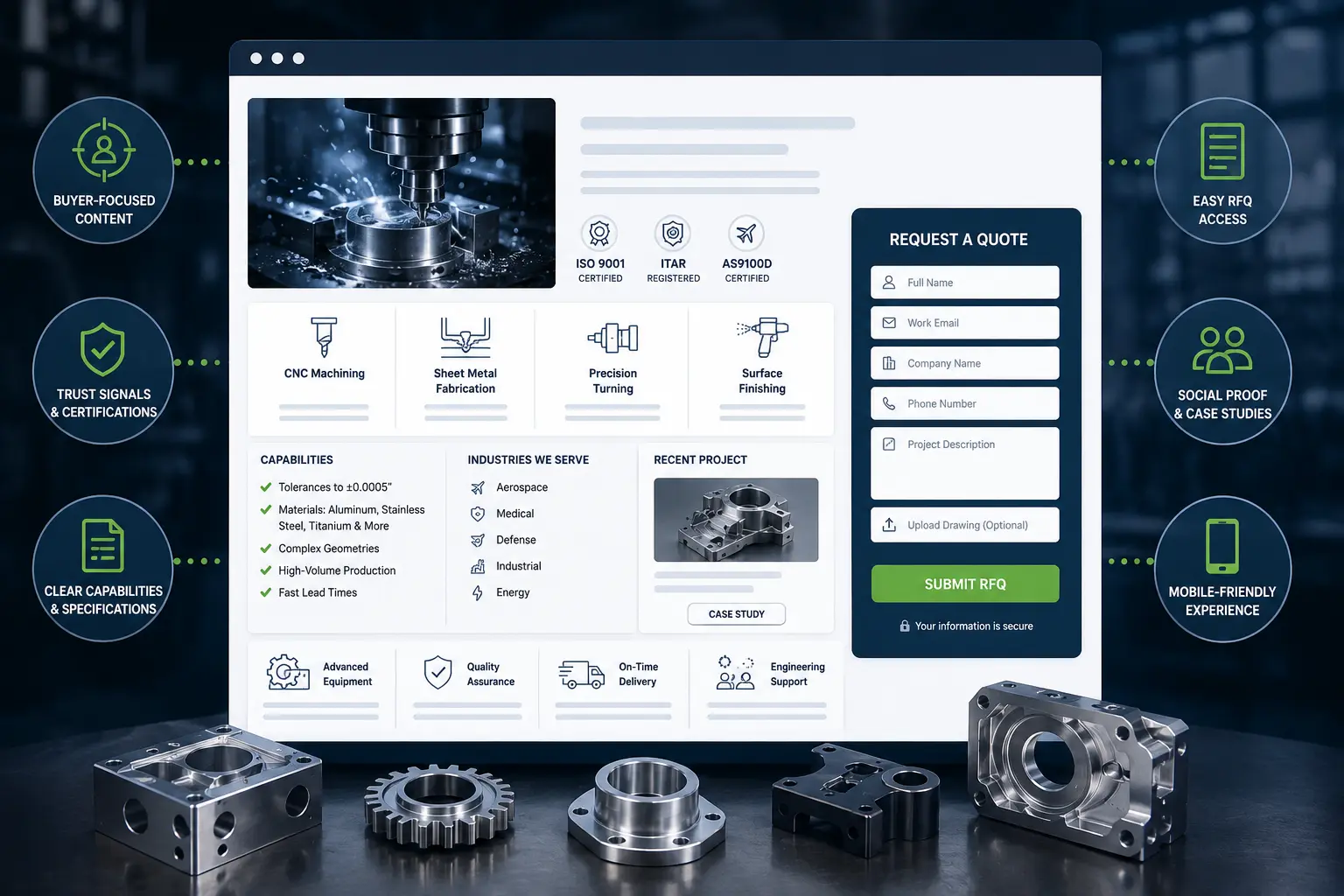
Getting the right traffic is only half the job. Once buyers arrive, your pages need to convert them. Here is where most manufacturers lose the sale they do not even know they were close to winning.
Product and Capability Pages
These are the most important pages on your manufacturing website. Most manufacturers treat them as static listing pages. High-performing supplier websites treat them as conversion tools.
Each capability page should include the process description, materials handled, tolerances, equipment used, industries served, and a clear CTA to request a quote. Write for two audiences at once: the engineer who wants technical depth, and the procurement manager who wants to know you can deliver.
Avoid vague language. Replace “high-quality manufacturing” with something like “ISO 9001-certified precision CNC machining for aerospace and medical components.”
The RFQ Form
The RFQ form is where traffic either converts or disappears.
Keep it short. Buyers do not want to fill out a 20-field form before they have even decided to work with you. A good manufacturing RFQ form typically asks for: part name or description, material, quantity, required timeline, and upload option for drawings or specs.
Place the form on every capability page. Not just the contact page. A buyer reading about your sheet metal fabrication services should not have to hunt for how to get a quote.
Internal Linking Between Pages
How your pages connect matters for both Google and your buyers.
A buyer landing on your CNC machining page should be able to navigate to your aerospace capabilities page, then to your certifications page, then to your RFQ form. Each step moves them deeper into supplier evaluation mode.
Internal links also distribute page authority across your site. This is one of the fastest ways to improve rankings on product pages without building new backlinks.
Our SEO services include a full internal linking audit as part of every manufacturing engagement.
Mobile Performance and Page Speed
Procurement managers check supplier websites between meetings. On their phone.
If your product pages take more than three seconds to load on mobile, a meaningful percentage of your buyers will leave before they ever see your capabilities. Core Web Vitals now directly affect search rankings, but more importantly, they affect whether a buyer trusts your website enough to stay.
Large image files on catalog pages are the most common culprit. Compress them. If your site was built for desktop and never optimized for mobile, that is worth addressing before anything else.
The Role of SEO in Manufacturing Lead Generation
Search engine optimization in manufacturing is not about getting as much traffic as possible. It is about appearing in front of the right buyer at the right stage of their decision.
A supplier that ranks for “custom aluminum extrusion manufacturer” is visible to a buyer who is actively sourcing. That is the kind of visibility that fills an RFQ pipeline.
The keyword strategy for manufacturing SEO should focus on:
- Product + process combinations: “injection molding HDPE supplier”
- Capability + certification: “ISO 9001 precision machining shop”
- Process + industry served: “CNC machining aerospace components”
- Location + process: “metal fabrication supplier Texas”
These combinations have lower search volume than broad terms, but they match how serious buyers actually search. That specificity is exactly what makes them valuable.
Technical SEO matters a great deal for large manufacturing websites. If your product catalog has hundreds of pages, crawl efficiency, internal linking structure, and proper indexing directly affect which pages Google shows to buyers.
It is also worth noting that AI-powered search tools like Perplexity, Gemini, and ChatGPT increasingly pull supplier information from well-structured, authoritative pages. If your capability pages are written clearly, with specific technical language and structured information, you are more likely to be surfaced when a buyer asks an AI tool for supplier recommendations.
Content That Supports the Buyer Journey
There is a common misconception in manufacturing marketing: that blog content does not generate leads.
That depends entirely on what you write.
Educational content like “what is die casting” does not move buyers closer to an RFQ. Procurement-stage content does.
Articles like these actually support the buying decision:
- “What certifications should you verify before choosing a CNC machining partner?”
- “How to evaluate a metal fabrication supplier before sending drawings”
- “What information should be in a complete RFQ for custom parts?”
This type of content meets buyers who are already evaluating suppliers. It builds trust before the first phone call. It also functions as a pre-qualification tool. A buyer who reads your content and recognizes your expertise comes into the conversation already sold on your credibility.
Industry application pages are another high-converting content asset that many manufacturers overlook. A dedicated page for “precision machining for medical devices” does more for your RFQ pipeline than a generic capability overview.
According to HubSpot, companies with 10 to 15 landing pages generate 55% more leads than those with fewer than 10. For manufacturers, capability-specific pages and application pages function as those landing pages.
How to Track RFQ Conversions from Your Website
Many manufacturers generate leads but cannot tell you which channel they came from. That makes it impossible to invest in what is working.
Setting up proper RFQ conversion tracking does not require complex infrastructure. Here is a practical starting point:
Set up your RFQ form submission as a conversion event in Google Analytics 4. This means every time a buyer completes and submits a quote request form, the system records it and ties it back to the traffic source that brought them in.
From there, you can see: did this RFQ come from organic search, a paid ad, a referral from an industry directory, or a direct visit? That attribution data tells you exactly where to focus budget and effort.
Track which product and capability pages drive the most form submissions. Often, a small number of pages generate the majority of RFQs. Improving those pages further, or replicating their structure for underperforming pages, compounds results quickly.
The reporting framework that matters in manufacturing lead generation looks like this: keyword rankings to qualified organic traffic, to product page engagement, to RFQ form completions, to sales conversations, to contracts. Every step in that chain should be visible.
Real Manufacturing SEO Results: Increased Visibility and Qualified Traffic
Data is valuable only when it translates into business outcomes.
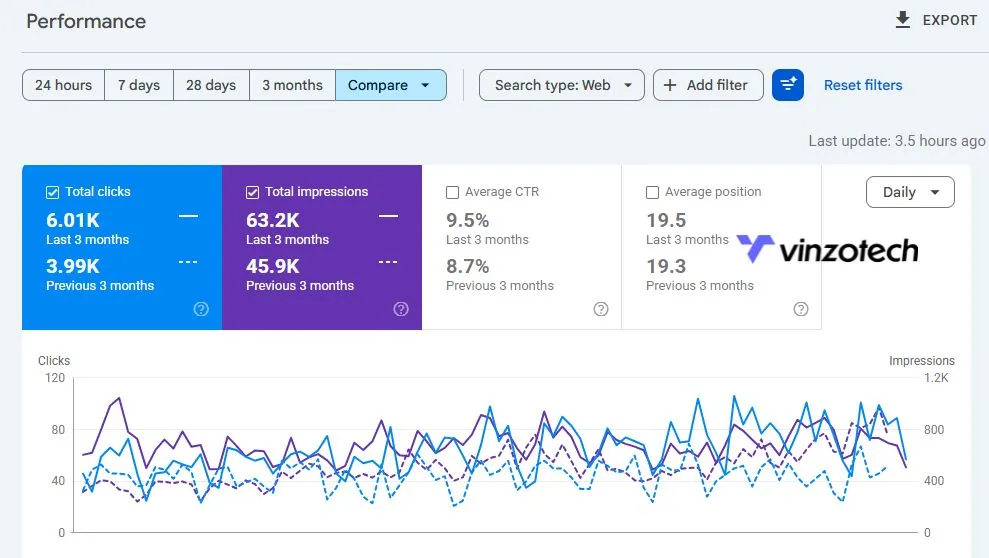
The Google Search Console performance report below highlights the impact of a targeted manufacturing SEO strategy over two consecutive three-month periods.
Key improvements include:
- Clicks increased from 3.99K to 6.01K
- Impressions grew from 45.9K to 63.2K
- Average CTR improved from 8.7% to 9.5%
- Search visibility expanded while maintaining stable rankings
These results were achieved by focusing on the factors that influence manufacturing buying decisions, including procurement-intent keywords, optimized capability pages, stronger internal linking, technical SEO improvements, and content aligned with how engineers and sourcing teams search for suppliers.
For manufacturers, success is not measured by traffic alone. The goal is to attract qualified visitors who are actively evaluating suppliers and ready to submit RFQs.
Client data has been anonymized to protect confidentiality. Results may vary depending on industry, competition, website condition, and market demand.
Data source: Google Search Console | Reporting period: Last 3 months compared with the previous 3 months.
Common Mistakes That Kill Manufacturing Lead Generation
These are the patterns that consistently prevent manufacturing websites from converting traffic into RFQs.
No clear next step after a capability page. A buyer reads about your services, feels confident in your capabilities, and then… there is no obvious place to go. Every product page and capability page needs a clear, visible CTA to request a quote.
Generic contact forms. A form that just asks for name, email, and message does not help a buyer communicate what they need. It also signals to serious procurement teams that your inquiry process is not set up for technical projects.
Targeting traffic over intent. Chasing high-volume keywords that do not match buyer behavior is a common trap. More sessions do not equal more RFQs. Procurement-intent sessions do.
Hiding the RFQ path. If your quote request form is three clicks away from your homepage, you are losing buyers who are ready to convert but unwilling to search for how to do it.
Neglecting mobile. A slow, poorly formatted product page on mobile is effectively invisible to buyers checking suppliers between meetings.
Content that informs but does not convert. Blog content that ranks well but never connects the reader to your services or your RFQ form generates traffic with no commercial outcome.
How AI Search Changes Manufacturing Lead Generation
Industrial buyers are changing how they research suppliers.
Instead of relying only on traditional search engines, many engineers, procurement teams, and operations managers now use AI-powered tools to find answers, compare suppliers, and evaluate manufacturing capabilities.
Platforms such as ChatGPT, Perplexity, Gemini, and Copilot can summarize information, recommend suppliers, and answer technical questions without requiring users to visit multiple websites.
A buyer searching for:
- “Who are the top CNC machining suppliers for aerospace components?”
- “Which manufacturers offer ISO 13485-certified medical device machining?”
- “What should I look for in a metal fabrication partner?”
may receive recommendations directly within an AI-generated response.
This shift is changing how manufacturers attract qualified traffic and generate RFQs.
From Search Rankings to Search Visibility
Traditional SEO focuses on improving rankings in search engine results pages.
AI search introduces a new goal: becoming a trusted source that AI platforms reference when answering buyer questions.
That is where Answer Engine Optimization (AEO) and Generative Engine Optimization (GEO) come into play.
Answer Engine Optimization focuses on structuring content so AI assistants can easily understand and surface it in response to user questions.
Generative Engine Optimization focuses on improving your visibility within AI-generated answers across platforms such as ChatGPT, Gemini, Perplexity, and other generative search tools.
For manufacturers, this means your website needs to do more than rank well. It needs to provide clear, structured, and authoritative information that AI systems can interpret with confidence.
What Manufacturing Buyers Ask AI Tools
Manufacturing buyers often ask highly specific questions.
Examples include:
- Which certifications should a medical device manufacturer have?
- What tolerance levels can precision CNC machining achieve?
- Who are reliable sheet metal fabrication suppliers in Texas?
- How do I evaluate an injection molding supplier?
- What information should be included in an RFQ?
Manufacturers that publish detailed answers to these questions increase their chances of being discovered through AI-powered search experiences.
How Manufacturers Can Improve AI Search Visibility
To improve visibility in AI-generated results, manufacturers should focus on creating content that answers real buyer questions.
Key strategies include:
- Create dedicated capability pages for each process and industry.
- Include technical specifications, tolerances, materials, and certifications.
- Publish industry-specific case studies and application pages.
- Add FAQ sections that address procurement and engineering concerns.
- Use clear headings and logical content structure.
- Implement structured data markup where appropriate.
- Keep company information, certifications, and contact details up to date.
- Build authority through industry publications, associations, and backlinks.
Specificity matters.
A page titled “CNC Machining Services” provides less value than a page focused on “AS9100-Certified CNC Machining for Aerospace Components.”
The more precise your content is, the easier it becomes for AI tools to understand when your company is relevant to a buyer’s request.
Why Technical Content Matters More Than Ever
AI systems favor content that demonstrates expertise and provides direct answers.
Manufacturers have a natural advantage because they already possess the information buyers want:
- Material capabilities
- Production processes
- Equipment details
- Industry certifications
- Quality standards
- Lead times
- Industry experience
The challenge is making that information accessible online.
Capability pages, specification sheets, industry pages, and technical resources are no longer just marketing assets. They help AI systems understand your business and connect buyers with the right supplier.
The Future of Manufacturing Lead Generation
AI search will not replace traditional search engines, but it is changing how buyers discover and evaluate suppliers.
Manufacturers that invest in SEO, Answer Engine Optimization, and Generative Engine Optimization can improve their visibility across both traditional search results and AI-powered platforms.
The goal remains the same: provide accurate information, answer buyer questions clearly, and make it easy for prospects to request a quote.
When your content aligns with how engineers and procurement teams search, your website becomes a stronger source of qualified manufacturing leads and RFQs.
FAQs On Manufacturing Lead Generation
Manufacturing lead generation is the process of attracting potential buyers and converting them into qualified opportunities. It involves reaching engineers, procurement teams, and decision-makers through channels such as SEO, paid advertising, industry directories, content marketing, and email campaigns to generate RFQs and sales inquiries.
Manufacturers can generate more RFQs by targeting buyer-intent keywords, creating detailed capability pages, showcasing certifications and industry experience, simplifying RFQ forms, and making it easy for buyers to find technical information such as tolerances, materials, and lead times.
The most effective channels depend on your goals and target market, but manufacturers often see strong results from SEO, Google Ads, industry directories, LinkedIn outreach, email marketing, and trade shows. SEO is particularly valuable because it captures buyers who are actively searching for suppliers.
A manufacturing RFQ form should collect the details buyers need to communicate project requirements clearly. Common fields include part description, material specifications, quantity, target timeline, industry requirements, drawing or CAD file uploads, and contact information.
Manufacturing SEO is a long-term strategy. Most companies begin seeing improvements in rankings and qualified traffic within three to six months, while meaningful increases in RFQs often occur within six to twelve months, depending on competition, website quality, and content depth.
Many manufacturing websites attract informational traffic instead of procurement-ready buyers. Common issues include targeting broad keywords, lacking detailed capability pages, hiding certifications, using generic contact forms, and providing no clear path to request a quote.
Manufacturers should focus on buyer-intent keywords that combine products, processes, industries, certifications, and locations. Examples include:
– CNC machining supplier for aerospace components
– ISO 9001 metal fabrication company
– Medical device injection molding manufacturer
– Precision machining services in Texas
These keywords typically generate fewer visits but attract more qualified prospects.
Manufacturers can improve RFQ conversion rates by placing quote request forms on capability pages, displaying certifications prominently, publishing case studies, improving mobile performance, reducing page load times, and providing clear technical specifications.
Key metrics include qualified RFQs, RFQ conversion rate, organic traffic from buyer-intent keywords, cost per lead, capability page engagement, sales-qualified opportunities, and revenue generated from marketing efforts.
Answer Engine Optimization (AEO) helps manufacturers structure content so that AI-powered tools can easily understand and surface it in response to buyer questions. Generative Engine Optimization (GEO) focuses on improving visibility within AI-generated answers from platforms such as ChatGPT, Gemini, and Perplexity. Both strategies help manufacturers reach buyers who use AI tools to research suppliers and compare capabilities.
Conclusion
Traffic does not build your pipeline. Qualified buyer traffic, paired with pages built to convert, does.
The difference between a manufacturing website that generates five inquiries a month and one that generates fifty is not content volume or ad spend. It is alignment between what buyers are searching for, what your pages communicate, and how clearly you make it for them to take the next step.
Every part of this matters: the keywords you target, how your capability pages are structured, where your RFQ form sits, how fast your pages load, what your content actually answers, and how precisely you track what is working.
For manufacturers who want to build a consistent RFQ pipeline from their website, VinzoTech works with industrial companies to improve supplier search visibility, structure capability pages for buyer conversion, and build digital marketing strategies tied to real business outcomes. Not just sessions. Not just rankings. RFQs.
Ready to turn your website into a consistent source of qualified manufacturing inquiries? Book a free strategy call with VinzoTech.